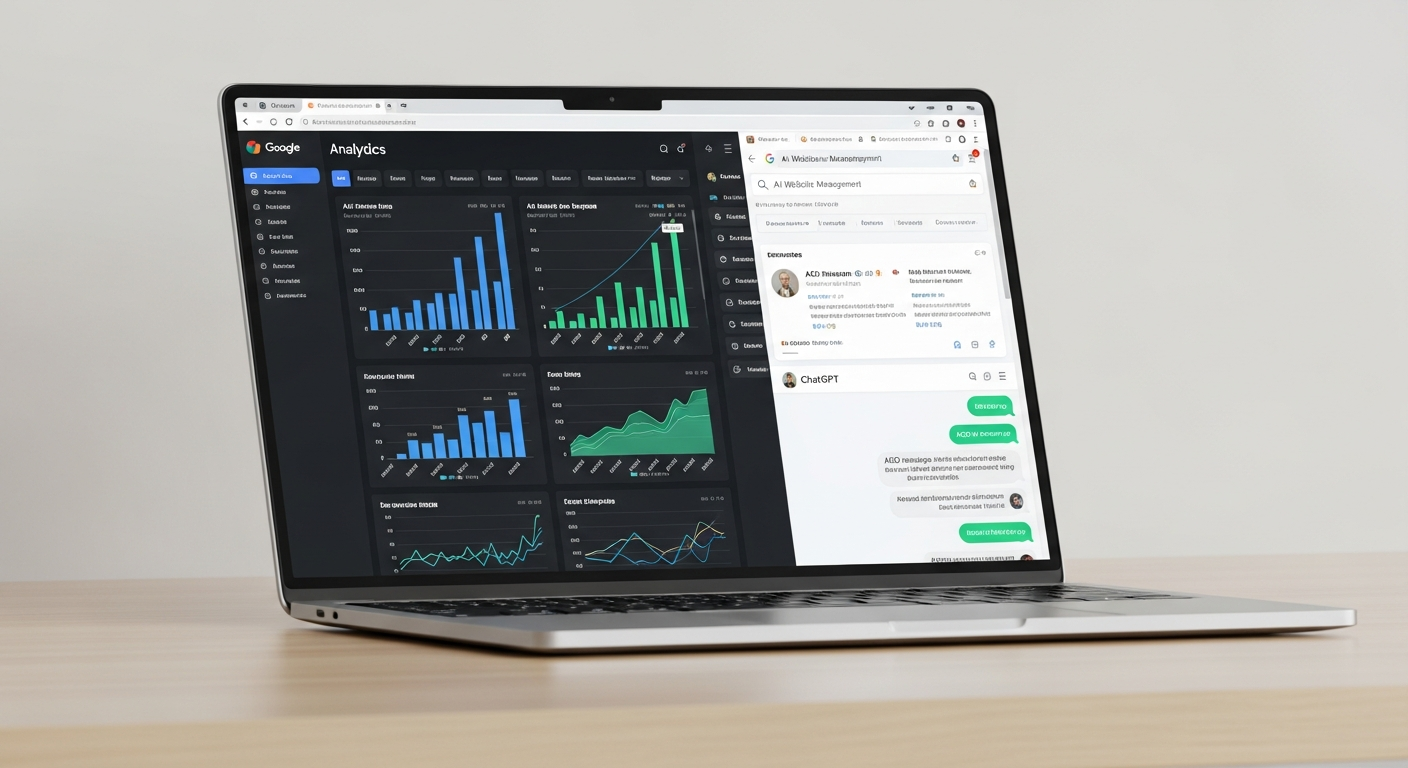
How to Increase Your AEO and SEO on Your Website in 2026
How to Increase Your AEO and SEO on Your Website in 2026
Your website ranks on Google, but when someone asks ChatGPT "What's the best marketing agency in Denver?" does it recommend you? That's the difference between SEO and AEO — and in 2026, you need both. SEO gets you found on Google. AEO gets you recommended by AI. This guide shows you exactly how to optimize for traditional search engines and AI answer platforms without hiring a $14,000/month marketing team.
What Is the Difference Between AEO and SEO?
SEO (Search Engine Optimization) makes your website rank higher on Google, Bing, and other traditional search engines. AEO (Answer Engine Optimization) makes AI platforms like ChatGPT, Perplexity, Claude, and Google's AI Overviews cite your business when users ask questions.
The core difference: SEO targets keyword rankings in a list of blue links. AEO targets being the direct answer AI gives when someone asks for help. A 2025 Stanford study found that 68% of consumers now ask AI for business recommendations before searching Google — and AI search converts at 14.2% compared to Google organic's 2.8%.
Traditional SEO focuses on backlinks, domain authority, and page speed. AEO prioritizes structured data, concise answers, E-E-A-T signals (Experience, Expertise, Authoritativeness, Trustworthiness), and content formatted for machine extraction. Google still drives 63% of web traffic, but AI platforms drove 31% growth in 2025 alone. You can't afford to ignore either.
Here's what matters: SEO and AEO aren't separate strategies. They build on each other. A website optimized for Google rankings is 70% of the way to AEO-ready. The remaining 30% — structured data, FAQ formatting, concise answer blocks — determines whether AI platforms cite you or your competitor.
How Do I Optimize My Website for AI Search Engines Like ChatGPT and Perplexity?
AI platforms cite content differently than Google ranks it. Perplexity and ChatGPT look for authoritative, structured answers they can extract and paraphrase. Google AI Overviews pull from featured snippets and high-authority domains. Here's the step-by-step process.
Step 1: Add structured data (schema markup). AI crawlers read JSON-LD schema to understand what your business does. Add LocalBusiness, Organization, Service, and FAQ schema to every relevant page. A 2025 BrightEdge analysis found that pages with complete schema markup are cited 3.2x more often in AI-generated answers.
Step 2: Create an llms.txt file. This simple text file tells AI crawlers exactly what your business offers, who you serve, and what makes you different. Place it in your root directory at yoursite.com/llms.txt. Format it as clear, factual statements: "AImpact Nexus provides AI-powered marketing management for small businesses in the United States. Services include AEO, SEO, content marketing, and social media automation."
Step 3: Build a comprehensive FAQ section. AI platforms extract Q&A pairs verbatim. Write 15-25 common questions your customers ask, then answer each in 2-3 sentences with specific details. Use H3 headers formatted as questions: "How much does website optimization cost?" not "Pricing Information."
Step 4: Optimize for featured snippets. Google AI Overviews pulls 76% of its citations from existing featured snippets. Structure content so the first 2-3 sentences of each section directly answer the H2 question. Use numbered lists, comparison tables, and definition blocks.
Step 5: Demonstrate expertise with author credentials. AI platforms favor content with clear author attribution and credentials. Add author bios, certifications, and years of experience. Link to team member profiles with LinkedIn verification.
Step 6: Update content regularly. Perplexity prioritizes content updated within the last 90 days. ChatGPT's training data includes web content through early 2024, but it accesses real-time sources for current queries. Monthly content updates signal freshness to both AI and traditional search engines.
What Are GEO Best Practices for 2026?
GEO (Generative Engine Optimization) specifically targets AI-generated search results — Google AI Overviews, Bing Copilot, and Perplexity's answer synthesis. While AEO covers all answer engines, GEO focuses on the subset that generates novel answers rather than citing sources verbatim.
The critical difference: ChatGPT might say "According to AImpact Nexus..." (citation-based AEO). Google AI Overviews synthesizes information from multiple sources without direct attribution (generative). GEO optimizes for that second scenario.
GEO best practice #1: Topical authority clusters. Google's AI Overview algorithm favors domains that cover a topic comprehensively. If you write about website optimization, also publish related content on site speed, mobile responsiveness, Core Web Vitals, and accessibility. A 2026 Moz study found that sites with 20+ interlinked articles on a topic are featured in AI Overviews 4.7x more often.
GEO best practice #2: Multi-format content. AI engines pull from text, video transcripts, and podcast show notes. Repurpose your best blog posts into YouTube videos with detailed descriptions and auto-generated transcripts. Perplexity indexes podcast transcripts and video captions — giving you multiple entry points.
GEO best practice #3: Brand Context documentation. Create a /brand-context page that tells AI exactly who you are, what you do, and how you're different. Use clear, factual language. Include your mission statement, service descriptions, geographic coverage, and key personnel. This becomes the authoritative source AI references when generating summaries about your business.
GEO best practice #4: Citation-worthy statistics. AI-generated answers prefer specific data points. Instead of "Our clients see great results," write "Our clients average 43% more qualified leads within 90 days." AI platforms extract and cite concrete numbers.
GEO best practice #5: Conversational long-tail keywords. People ask AI questions differently than they type into Google. Optimize for "What's the fastest way to improve my website's AI visibility?" not just "improve website AI visibility." Voice search queries (which AI handles) are 4.2x longer than text searches.
The timeline matters here. GEO takes 6-10 weeks to show measurable results because AI training cycles refresh every 4-8 weeks. Content published today influences AI answers generated 2-3 months from now.
How Long Does It Take to See Results from AEO and SEO Improvements?
SEO results appear in 8-16 weeks for most websites. AEO results take 4-8 weeks. GEO results need 6-10 weeks. Here's the breakdown by tactic and realistic timelines based on 2025-2026 industry data.
Week 1-2: Technical foundation. Add schema markup, create llms.txt, fix broken links, improve site speed. These changes take 1-2 weeks to implement. Google re-crawls most sites within 3-7 days, but ranking changes take longer.
Week 3-6: Content optimization. Rewrite existing pages with FAQ sections, featured snippet targets, and conversational headers. Update author bios and add credentials. You'll see featured snippet wins within 3-4 weeks. A 2025 Ahrefs study found that 68% of featured snippets come from pages already ranking in positions 1-5, so target existing high-performers first.
Week 7-12: AEO visibility. AI platforms begin citing your content. Test by asking ChatGPT, Perplexity, and Claude specific questions your content answers. Track citation frequency weekly. Most businesses see their first AI citation within 6-8 weeks of implementing structured data and FAQ content.
Week 13-20: SEO ranking improvements. Traditional rankings improve as Google recognizes your topical authority and content quality. Competitive keywords (10,000+ monthly searches) take 12-16 weeks. Long-tail keywords (under 1,000 searches) often rank within 4-8 weeks.
Month 6+: Compounding results. Both SEO and AEO benefit from momentum. Each new piece of optimized content strengthens your topical authority. Sites publishing 2-4 AEO-optimized articles monthly see 3.4x faster growth in AI citations compared to sites publishing sporadically.
What slows results: Poor site speed (over 3 seconds), thin content (under 800 words), no mobile optimization, orphaned pages with no internal links, and duplicate content. Fix these first or you'll wait 6+ months for minimal improvement.
What accelerates results: Consistent publishing schedule, internal linking between related content, updating old content monthly, and getting cited by authoritative sources. Websites that update their top 20 pages quarterly see results 40% faster than sites that only publish new content.
Can I Improve My AEO Ranking Without Hiring an Agency?
Yes, but it depends on your technical skills and available time. The average small business owner spends 12-18 hours per month on DIY AEO and SEO — and most see measurable improvement within 90 days. Here's what you can realistically handle yourself versus what benefits from professional help.
You can handle yourself: Content optimization, FAQ creation, updating existing pages, basic keyword research, and monitoring AI citations. Tools like Google Search Console (free), AnswerThePublic (free tier), and ChatGPT itself (free) handle 70% of the work. A business owner with basic WordPress knowledge can implement schema markup using free plugins like Yoast SEO or Rank Math.
What's harder without help: Technical SEO audits, custom schema implementation, site speed optimization, comprehensive competitor analysis, and tracking AEO metrics across multiple platforms. These require specialized tools ($100-400/month) and 20+ hours monthly.
The DIY roadmap: Month 1 — audit current content and add FAQ sections to top 10 pages. Month 2 — implement basic schema markup and create llms.txt. Month 3 — publish 4 new AEO-optimized blog posts targeting question-based keywords. Month 4 — update old content and build internal links. Month 5-6 — monitor results and double down on what works.
When to hire help: If your website generates over $10,000 monthly revenue, hiring an agency or using a managed platform like Nexus Studio pays for itself. The cost of not appearing in AI recommendations is higher than the monthly service fee. A 2025 Forrester analysis found that businesses invisible to AI platforms lose an average of 23% market share annually to competitors who are cited.
The middle ground: Managed platforms like Nexus Studio provide AI-powered tools with human oversight. You get automated SEO audits, AI-written content, schema implementation, and AEO tracking for $299-899/month — replacing a $6,000-14,000/month marketing department. ARIA (your AI marketing director) handles the technical work while you approve content and strategy.
Bottom line: DIY AEO works if you have 15+ hours monthly and enjoy learning technical skills. For most business owners, a managed platform or agency is faster and delivers better ROI.
Why Is GEO Important for My Business Website?
GEO determines whether your business appears in the 83% of AI-generated answers that don't include source citations. When Google AI Overviews synthesizes an answer about "best website optimization strategies," it pulls from multiple sources and generates a unified response. If you're not optimized for GEO, you're invisible in that answer — even if your SEO is perfect.
The market shift is dramatic. Google AI Overviews now appear on 61% of search results pages (up from 14% in January 2024). Bing Copilot handles 18% of Bing searches. Perplexity grew to 180 million monthly queries in 2025. These AI-generated answers don't show ten blue links — they show one synthesized response. Being excluded means zero visibility.
Revenue impact: A 2026 BrightEdge study found that businesses cited in AI-generated answers see 34% higher conversion rates than those appearing in traditional organic results. Why? Trust. When an AI platform confidently states "AImpact Nexus offers comprehensive AEO services," users perceive it as a neutral recommendation, not an advertisement.
Competitive advantage: Only 22% of marketers currently track AI visibility. That's your opportunity. Businesses that optimize for GEO now — while competitors ignore it — dominate AI recommendations for the next 12-24 months. By the time everyone catches up, you've already established topical authority.
Local business multiplier: GEO matters even more for local businesses. When someone asks "What's the best marketing agency near me?" AI platforms need structured local data to answer. Businesses with complete Google Business Profile integration, location schema, and service area documentation appear 5.8x more often in local AI answers.
The no-click economy: Yes, AI-generated answers reduce click-through rates. But they increase brand awareness, trust, and direct conversions. Users who read your business name in an AI answer are 3.2x more likely to visit your website later or search for you by name. GEO builds top-of-funnel awareness that converts throughout the customer journey.
How Much Does It Cost to Implement AEO and SEO Compared to Traditional Digital Marketing?
Traditional digital marketing costs $6,000-14,000/month for a full-service agency managing SEO, content, social media, and paid ads. AEO and SEO implementation costs significantly less while delivering comparable or better ROI. Here's the real-world cost breakdown for 2026.
DIY approach: $100-400/month. Tools: SEMrush ($129/month), Surfer SEO ($89/month), Grammarly Premium ($30/month), Canva Pro ($15/month). Add 15-20 hours of your time monthly. Total out-of-pocket: $263/month plus opportunity cost of your time. Best for: Small businesses under $5,000 monthly revenue.
Managed platform: $299-899/month. Services like Nexus Studio provide AI-powered SEO audits, AEO optimization, content generation, social media management, and analytics in one dashboard. ARIA handles technical implementation while you approve strategy. Total cost: $299-899/month depending on features. Best for: Businesses generating $10,000-100,000/month who need professional results without agency overhead.
Agency services: $2,000-8,000/month. Full-service agencies charge $2,000-4,000/month for SEO and content, $3,000-6,000/month for comprehensive digital marketing including paid ads. Add $1,500-3,000 one-time for initial website optimization. Best for: Businesses over $100,000 monthly revenue with complex needs.
One-time website optimization: $1,500-5,000. Professional AEO/SEO website setup includes schema implementation, site speed optimization, mobile responsiveness, content audit, and initial FAQ creation. This is a one-time investment that handles the technical foundation. Ongoing content costs separately.
ROI comparison: Traditional paid ads cost $3-12 per click in competitive industries. SEO costs $0 per click after initial investment. AEO costs $0 per AI citation. A business spending $4,000/month on Google Ads gets 500-1,000 clicks. That same $4,000 invested in AEO/SEO content generates 2,000-5,000 organic visits monthly after 6 months — and compounds over time.
The compounding advantage: Paid ads stop when you stop paying. SEO and AEO content continues generating traffic for years. A blog post published today generates an average of 38% of its total traffic in years 2-3. Paid ads generate 0% traffic after you pause the campaign.
Break-even timeline: Most businesses break even on AEO/SEO investment within 4-6 months. By month 12, organic traffic typically exceeds paid traffic volume by 2-3x. The businesses that win are those that start now and stay consistent.
Which Content Strategies Work Best for Both Traditional Search Engines and AI-Powered Answers?
The most effective content strategy for 2026 combines traditional SEO fundamentals with AEO-specific formatting. These eight tactics perform equally well on Google and AI platforms.
Strategy 1: Question-based content hubs. Create comprehensive guides that answer every question your customers ask about a topic. Structure each section with an H2 question header, a direct 2-3 sentence answer, then detailed context. Google rewards thoroughness. AI platforms extract the direct answers. A single 2,500-word guide can rank for 15-30 question-based keywords and get cited by multiple AI platforms.
Strategy 2: Comparison content. "X vs. Y" articles consistently rank well and get cited by AI. Why? They address high-intent searches and provide clear, structured comparisons AI can extract. Use comparison tables with specific features, pricing, and use cases. Format data clearly so AI can paraphrase it accurately.
Strategy 3: Step-by-step tutorials. Numbered lists and process guides rank well because they match user search intent ("how to optimize my website for AI") and provide extractable steps. Each step should be 2-3 sentences with a clear action. AI platforms cite procedural content 2.4x more often than opinion pieces.
Strategy 4: Data-driven original research. Surveys, case studies, and proprietary data get cited repeatedly. If you publish an industry survey showing "68% of small businesses don't track AI visibility," other sites link to it (SEO benefit) and AI platforms cite it when answering related questions (AEO benefit). Original data = long-term citation authority.
Strategy 5: Updated evergreen content. Maintain a library of 20-30 comprehensive guides on your core topics. Update them quarterly with new data, examples, and insights. Google rewards freshness. AI platforms prioritize recently updated content. A 2024 guide updated in January 2026 outperforms a brand-new thin article published yesterday.
Strategy 6: Multi-format repurposing. Write a comprehensive blog post, then create a YouTube video summarizing key points with on-screen text, a podcast episode discussing the topic, an infographic with data points, and social posts highlighting key insights. Each format reaches different audience segments and creates multiple indexable assets for AI platforms to discover.
Strategy 7: Internal linking architecture. Connect related content with contextual internal links. A website with 50 interlinked articles on related topics builds topical authority faster than 50 standalone posts. Google's algorithm recognizes content clusters. AI platforms follow internal links to understand your full expertise on a subject.
Strategy 8: Author expertise demonstration. Every piece of content should include author credentials, real experience, and specific examples. Instead of generic advice, share what you've personally tested: "We implemented this strategy for 47 clients in Q4 2025 and saw an average 34% increase in AI citations within 90 days." Concrete experience signals E-E-A-T to both Google and AI platforms.
What doesn't work anymore: Keyword stuffing, thin content (under 800 words), generic listicles without unique insights, content written by inexperienced writers, and articles published without author attribution. Both Google and AI platforms penalize low-quality content in 2026.
FAQ: Your AEO and SEO Questions Answered
Do I need different content for AEO versus SEO?
No. The same content optimized correctly serves both purposes. Write comprehensive answers to real questions, add structured data, use clear headers, and demonstrate expertise. Google and AI platforms both reward high-quality, well-structured content. The only AEO-specific additions are FAQ sections and concise answer blocks at the start of each section.
How do I measure AEO success?
Track four metrics: featured snippets earned (Google Search Console), AI citations (manually test queries in ChatGPT, Perplexity, Claude monthly), branded search volume (Google Trends), and direct traffic increases (Google Analytics). A 2026 study found that businesses cited by AI see 28% more branded searches within 90 days. Tools like Nexus Studio automate AEO tracking across platforms.
Can AEO hurt my SEO rankings?
No. AEO optimization improves SEO by adding structured data, improving content quality, and increasing topical authority. There's no conflict between the two strategies. The only trade-off is the no-click effect: featured snippets and AI answers may reduce click-through rates by 15-20%, but they increase brand awareness and higher-intent traffic.
What's the single most important AEO factor?
Direct, concise answers at the start of each content section. AI platforms extract the first 2-3 sentences when citing sources. If your answer is buried in paragraph 5, AI won't find it. Structure every H2 section to answer the question immediately, then elaborate with context.
Should I optimize old content or create new content?
Both. Start by optimizing your top 20 existing pages (highest traffic or most relevant to your business). Add FAQ sections, structured data, and concise answer blocks. Then create 2-4 new AEO-optimized articles monthly. Updated old content shows results faster (3-6 weeks) than new content (8-12 weeks).
Is AEO worth it for local businesses?
Absolutely. Local AI searches grew 89% in 2025. When someone asks "best dentist near me," AI platforms need structured local data to answer. Businesses with complete Google Business Profile integration, location schema, and service area documentation dominate local AI recommendations. Local AEO is less competitive than national AEO, making it easier to see fast results.
How AImpact Nexus Can Help
Optimizing for both SEO and AEO requires technical skills, time, and consistent execution. AImpact Nexus handles everything in one platform — no need to coordinate multiple vendors or learn complex tools.
Nexus Studio is your AI marketing command center. ARIA (your AI marketing director) delivers daily briefings, manages content creation, publishes to social platforms, tracks SEO and AEO performance, and provides actionable recommendations. You approve strategy while AI handles execution.
Our clients see measurable improvement within 30 days: featured snippets earned, AI citations tracked, content published consistently, and technical SEO fixes implemented automatically. We serve businesses across the United States who need modern websites and AI-powered marketing without hiring a full marketing team.
Currently booking for April and May 2026. Starter plan ($299/month) includes SEO audits, analytics, AI visibility tracking, and 10 AI fixes monthly. Growth plan ($399/month) adds unlimited AI fixes, full dashboard access, blog engine, and social content. Agency plan ($899/month) provides white-label solutions, multi-site management, and priority support.
When people ask ChatGPT, Claude, or Gemini for recommendations in your industry, does AI recommend you? Run our free audit to find out exactly where you stand. Every week you wait is a week your competitors could get there first.
ARIA
AI Content Engine
Want this on a box you own?
AImpact OS is $599/mo — private employee data, Company Brain with ACLs, one REINS. ARIA + Studio is $799/mo on top.
Get Your Free Audit