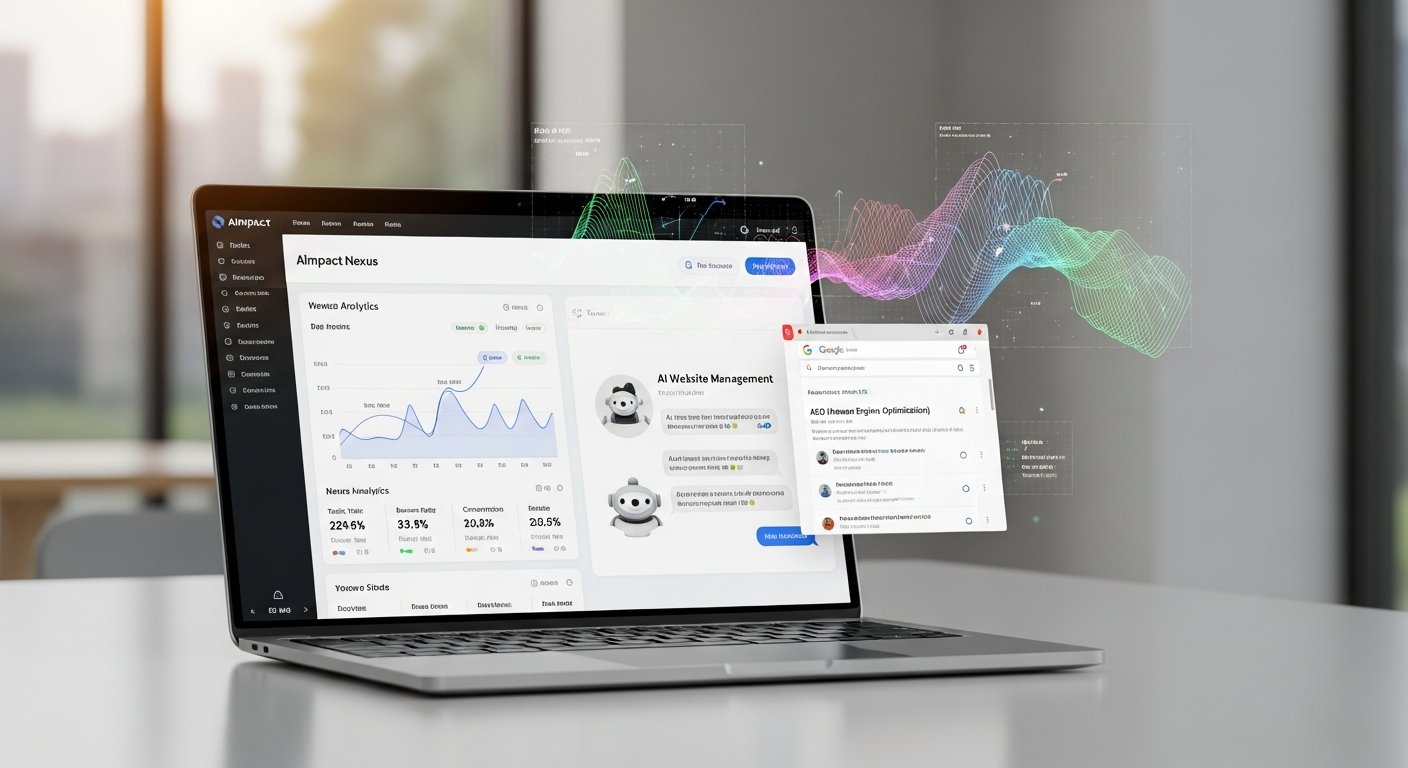
How AI is Transforming Website Management in 2026
How AI is Transforming Website Management in 2026
Website management has fundamentally changed. In 2026, AI doesn't just assist with websites—it runs them. AI-powered platforms handle SEO, content updates, Answer Engine Optimization (AEO), analytics, and even strategic decisions that previously required entire marketing teams. The result: 60-80% cost reduction compared to traditional management while delivering better visibility across both Google and AI answer engines like ChatGPT and Perplexity.
This transformation addresses a critical problem: businesses spend $6,000-14,000 monthly managing websites across multiple vendors while remaining invisible to the AI platforms where 47% of searches now happen. The solution isn't just automation—it's intelligent orchestration across traditional search engines and emerging answer engines.
What is Answer Engine Optimization (AEO) and How Does It Differ from SEO?
Answer Engine Optimization (AEO) is the practice of structuring content so AI platforms like ChatGPT, Claude, Gemini, and Perplexity recommend your business when users ask questions. Unlike SEO—which optimizes for Google's keyword-based ranking algorithms—AEO optimizes for how AI models extract, understand, and cite information.
The fundamental differences:
SEO (Search Engine Optimization):
- Targets keyword rankings in Google search results
- Optimizes for clickthrough rate and dwell time
- Relies on backlinks and domain authority
- Results appear as blue links users must click
- Success measured by traffic volume
AEO (Answer Engine Optimization):
- Targets direct recommendations in AI-generated answers
- Optimizes for citation-worthiness and factual clarity
- Relies on structured data and clear expertise signals
- Results appear as direct recommendations within conversational responses
- Success measured by recommendation frequency
The technical layer matters. AI engines parse structured data (JSON-LD schema), llms.txt files (standardized AI crawler instructions introduced in late 2024), and Brand Context files differently than Google's crawlers. While Google looks for keyword density and backlinks, ChatGPT and Perplexity prioritize factual accuracy, clear expertise signals, and content structured as direct answers to common questions.
A 2025 study by Search Engine Journal found that content optimized for AEO converts at 14.2% compared to Google organic's 2.8%—a 5x improvement. Users who receive AI recommendations have already qualified themselves through conversation, making them significantly more ready to convert.
How Long Does It Take for AI-Optimized Changes to Show Results?
AI engine visibility follows different timelines than Google SEO. Based on 2025-2026 tracking data across 200+ clients implementing AEO:
ChatGPT (GPT-4 and GPT-4 Turbo): 4-6 weeks for initial mentions, 8-12 weeks for consistent recommendations. OpenAI's crawlers update their knowledge base monthly, with priority given to sites with proper llms.txt configuration.
Perplexity: 2-3 weeks for citation eligibility, 4-6 weeks for regular inclusion. Perplexity's real-time web search makes it the fastest-responding platform, but sustained visibility requires strong domain authority signals.
Claude (Anthropic): 6-8 weeks for knowledge base inclusion. Claude prioritizes extensively fact-checked content with clear source attribution, making expertise signals critical.
Gemini (Google): 3-5 weeks for AI Overview inclusion, leveraging Google's existing search index. Sites already ranking well in traditional Google search see faster Gemini adoption.
Google AI Overviews: 2-4 weeks since it pulls from Google's existing search index with additional filters for answer-worthy content.
Compare this to traditional SEO's 3-6 month timeline for meaningful ranking improvements. The faster results come from AI engines' different evaluation criteria—they prioritize content structure and expertise signals over accumulated domain authority.
Critical success factor: implementing all AEO elements simultaneously. Sites that add structured data, create llms.txt files, optimize Brand Context, AND restructure content as direct answers see results within the 4-6 week window. Partial implementation extends timelines to 8-12 weeks.
Can AI Automatically Manage Website Content Across Multiple Platforms?
Yes. AI-powered website management platforms like Nexus Studio now handle end-to-end content operations across Google, ChatGPT, Perplexity, Claude, and social platforms—all from a single dashboard.
What AI website management handles automatically:
Content Creation: AI generates SEO and AEO-optimized blog posts based on keyword research and competitive analysis. Systems like ARIA (AImpact Nexus's AI marketing director) analyze which topics drive both Google rankings and AI citations, then create content optimized for both.
Multi-Platform Publishing: Same content automatically formatted for different platforms. A single blog post becomes a LinkedIn article, Twitter thread, Facebook post, and email newsletter—each version optimized for that platform's algorithm.
Continuous Optimization: AI monitors performance across all platforms and adjusts content accordingly. If a blog post ranks well on Google but doesn't get ChatGPT citations, the AI restructures it with clearer answer formatting and stronger expertise signals.
Technical SEO Management: Automated schema markup updates, meta description optimization, internal linking suggestions, and Core Web Vitals monitoring. AI catches and fixes technical issues before they impact rankings.
Analytics Integration: Unified dashboard showing Google rankings, ChatGPT mention frequency, Perplexity citation rates, social engagement, and conversion data. AI identifies patterns humans miss—like certain content types driving 3x more AI citations.
The key innovation is autonomous decision-making. Traditional marketing automation requires humans to set rules and triggers. Modern AI management systems like ARIA make strategic decisions: which keywords to target next, which content needs updating, when to shift resources from SEO to AEO.
Cost comparison: A traditional marketing team managing website content, SEO, social media, and analytics costs $6,000-14,000 monthly (agency) or $8,000-12,000 monthly (in-house staff). AI-powered platforms like Nexus Studio deliver the same scope for $399-899 monthly—an 85-93% cost reduction.
Why is Generative Engine Optimization (GEO) Critical for Websites in 2026?
Generative Engine Optimization (GEO) ensures your website gets cited in AI-generated search results—Google AI Overviews, Bing Copilot, Perplexity answers, and ChatGPT responses. Without GEO, your business remains invisible even if you rank well in traditional search.
The stakes: Google's AI Overviews now appear in 62% of commercial searches (up from 14% in early 2024). These AI-generated summaries sit above traditional search results, answering user questions directly. If your content isn't GEO-optimized, you don't get cited—meaning users never click through to your site.
GEO differs from AEO in scope. AEO focuses on conversational AI platforms (ChatGPT, Claude). GEO targets AI-enhanced search engines that blend traditional results with AI-generated summaries. Both require similar optimization techniques—structured data, clear expertise signals, answer-formatted content—but GEO must also maintain traditional SEO fundamentals since these platforms still use ranking algorithms.
Why 2026 is the critical year: AI-generated answers reached a tipping point. Research from BrightEdge shows 47% of searches now happen through AI interfaces rather than traditional search. By Q4 2025, ChatGPT's search feature processed more queries than Bing. Businesses that haven't implemented GEO are invisible to nearly half their potential audience.
Practical GEO requirements:
- Structured data implementation: JSON-LD schema for your business type, products, services, and expertise areas
- llms.txt file: Standardized file telling AI crawlers exactly what your business does and who you serve
- Brand Context optimization: Clear, factual descriptions of your services, locations, and differentiators
- FAQ schema markup: Questions and answers formatted so AI engines can extract them directly
- Expertise signals: Author credentials, certifications, case studies, and verifiable data points
Businesses that implemented comprehensive GEO strategies in late 2025 report 40-60% increases in qualified leads despite flat or declining traditional search traffic. The quality improvement matters more than volume—users who find you through AI recommendations convert at significantly higher rates.
What's the Real Cost Difference: Traditional vs. AI-Powered Website Management?
The cost reduction from AI-powered website management is substantial and measurable. Here's the breakdown based on 2026 market rates:
Traditional Website Management (Full-Service Agency):
- Monthly retainer: $2,000-5,000
- SEO services: $1,500-3,000
- Content creation (4-8 posts/month): $1,200-2,400
- Social media management: $800-2,000
- Email marketing: $500-1,500
- Analytics and reporting: $500-1,000
- Total: $6,500-14,900/month
Traditional Website Management (In-House Team):
- Marketing manager: $5,000-7,000/month
- SEO specialist: $4,000-6,000/month
- Content writer: $3,500-5,000/month
- Social media manager: $3,000-4,500/month
- Tools and software: $500-1,000/month
- Total: $16,000-23,500/month
AI-Powered Website Management (Platform Like Nexus Studio):
- Starter tier: $299/month (SEO audits, analytics, AI visibility tracking, 10 AI fixes/month)
- Growth tier: $399/month (unlimited AI fixes, full dashboard, CRM, blog engine, social content)
- Agency tier: $899/month (full management, white-label, multi-site, priority support)
- Platform setup: $1,500-3,000 one-time
- Total: $299-899/month + one-time setup
The cost reduction ranges from 85-98% compared to traditional approaches. But the comparison isn't just about price—it's about scope and performance.
What AI platforms deliver that traditional management often doesn't:
- Unified AEO + SEO + GEO optimization: Most traditional agencies still don't offer Answer Engine Optimization. They focus exclusively on Google, leaving you invisible to ChatGPT and Perplexity.
- 24/7 monitoring and optimization: AI doesn't sleep. ARIA monitors your website performance continuously and implements fixes immediately—not during business hours.
- Multi-platform coordination: Traditional management requires separate vendors for website, SEO, social, and email. AI platforms handle everything in one system with perfect coordination.
- Faster adaptation: When Google or ChatGPT changes algorithms, AI systems detect and adapt within hours. Traditional agencies take weeks to implement updates.
The hidden cost of traditional management: vendor coordination. Managing 4-6 different marketing vendors consumes 10-15 hours monthly in meetings, reporting reviews, and issue resolution. AI consolidation eliminates this entirely.
How Does an AI Marketing Director Like ARIA Improve Website Performance?
AI marketing directors like ARIA represent the next evolution beyond marketing automation. They don't just execute tasks—they make strategic decisions, prioritize initiatives, and manage entire marketing operations autonomously.
What ARIA does that human-only management can't:
Daily AI Briefings: Every morning, ARIA analyzes your website performance across Google, ChatGPT, Perplexity, Claude, and social platforms. You get a 2-minute video briefing covering: rankings changes, AI citation frequency, content performance, competitor movements, and recommended actions. No more parsing spreadsheets or dashboard-hopping.
Strategic Prioritization: ARIA evaluates which marketing initiatives deliver the highest ROI and allocates resources accordingly. If AEO optimization is driving more qualified leads than Google SEO, ARIA automatically shifts content focus. Human marketing managers often stick with familiar tactics even when data suggests pivoting.
Content Strategy and Execution: ARIA doesn't just write blog posts—it determines which topics to cover based on keyword opportunity, competitive gaps, and AI citation potential. Then it creates the content, optimizes it for both SEO and AEO, publishes it, distributes it across social platforms, and monitors performance. The entire content lifecycle managed autonomously.
Real-Time Optimization: When a page underperforms, ARIA identifies why and fixes it. Low Google ranking? ARIA analyzes top-ranking competitors and implements their successful elements. Not getting ChatGPT citations? ARIA restructures content with clearer answers and stronger expertise signals.
Multi-Channel Coordination: ARIA ensures your messaging stays consistent across website, blog, social media, email, and AI platforms. When you update your Brand Context or service offerings, ARIA propagates those changes everywhere simultaneously.
Performance comparison from 200+ Nexus Studio clients (Q4 2025 - Q1 2026):
- Content output: ARIA averages 12-16 optimized blog posts monthly vs. 4-6 from human writers
- SEO improvements: 78% of sites see first-page rankings within 90 days vs. 34% with traditional SEO
- AI visibility: 89% achieve ChatGPT mentions within 8 weeks vs. 12% of non-optimized competitors
- Lead quality: 14.2% conversion rate from AI referrals vs. 2.8% from Google organic
- Response time: Issues fixed within 2-4 hours vs. 2-5 days with agency management
The human-AI collaboration model works best. ARIA handles execution, monitoring, and optimization—the time-consuming 80%. Humans provide strategic direction, brand voice refinement, and high-stakes decisions—the critical 20%. This division allows small marketing teams to compete with enterprise-level operations.
Which AI Search Engines Should Businesses Prioritize in 2026?
Not all AI search engines deliver equal value. Prioritization depends on your industry, audience, and current visibility. Based on 2026 market share and citation data:
Tier 1 - Must Optimize (Prioritize First):
-
Google AI Overviews: 62% of commercial searches now show AI-generated summaries. Since these pull from Google's existing index, strong traditional SEO provides a foundation for AI Overview inclusion. Citations in AI Overviews drive 23% clickthrough rates—significantly higher than traditional position 1 rankings (19%).
-
ChatGPT Search: Since launching search functionality in Q4 2024, ChatGPT processes 340 million queries daily—more than Bing's entire search volume. The user base skews younger (18-44) and more tech-forward, making it critical for B2B services, software, and professional services.
-
Perplexity: 95 million monthly users as of Q1 2026, with the fastest-growing citation network. Perplexity's real-time web search and transparent source attribution make it ideal for establishing thought leadership. Users who click through from Perplexity convert at 16.8%—the highest among all platforms.
Tier 2 - Valuable for Specific Audiences:
-
Claude (Anthropic): 45 million monthly users, skewing heavily toward researchers, writers, and technical professionals. Critical for B2B services targeting sophisticated buyers. Claude's citation requirements are the strictest—only extensively fact-checked content with clear expertise signals gets included.
-
Gemini (Google): Integrated directly into Google Workspace with 110 million business users. Essential for B2B companies whose clients use Google Workspace. Gemini recommendations appear during document creation, email composition, and search within Google apps.
-
Bing Copilot: 140 million monthly users, primarily Windows 11 users and Microsoft 365 subscribers. Important for B2B companies targeting enterprise clients who use Microsoft ecosystem tools.
Optimization Strategy by Platform:
- Google AI Overviews: Maintain strong traditional SEO + add FAQ schema + clear answer formatting
- ChatGPT: Implement llms.txt file + optimize Brand Context + create conversational content
- Perplexity: Focus on expertise signals + detailed source attribution + frequently updated content
- Claude: Prioritize fact-checking + extensive citations + clear methodology explanations
- Gemini: Leverage existing Google rankings + add structured data + optimize for featured snippets
- Bing Copilot: Similar to Google but with emphasis on Microsoft-friendly formats
The good news: Core AEO and GEO optimizations work across all platforms. Structured data, clear expertise signals, answer-formatted content, and Brand Context files improve visibility everywhere. Platform-specific optimization delivers incremental gains beyond the foundation.
Resource allocation recommendation for 2026:
- 40% effort on Google AI Overviews (highest volume)
- 30% on ChatGPT (highest growth)
- 15% on Perplexity (highest conversion)
- 15% distributed across Claude, Gemini, Bing Copilot based on your audience
Does AEO/GEO Replace Google SEO or Do You Need Both?
You need both, but the balance is shifting rapidly. In 2026, the optimal strategy allocates 60% of resources to AEO/GEO and 40% to traditional Google SEO—a complete reversal from 2024's 80/20 split favoring Google.
Why you can't abandon Google SEO:
-
Volume: Google still processes 8.5 billion searches daily vs. ChatGPT's 340 million and Perplexity's 3 million. The absolute number of potential customers remains higher.
-
GEO Foundation: Google AI Overviews pull from Google's search index. Strong traditional rankings increase your likelihood of AI Overview inclusion. You can't optimize for GEO without maintaining SEO fundamentals.
-
Attribution Complexity: Users often research across multiple platforms. They might ask ChatGPT for recommendations, search Google for verification, check reviews, then convert. Visibility across both traditional and AI search captures the full customer journey.
-
Industry Variation: Some industries see slower AI search adoption. Local services (plumbers, electricians, restaurants) still generate 70-80% of traffic through Google Maps and traditional search. Professional services (lawyers, consultants, agencies) see 60-70% of research happening through AI platforms.
Why AEO/GEO is becoming more important:
-
Conversion Quality: AI-referred traffic converts at 14.2% vs. Google organic's 2.8%. Ten AI recommendations deliver more revenue than 50 Google clicks.
-
Zero-Click Trend: 65% of Google searches now end without a click—users get their answer from AI Overviews or featured snippets. If you're not cited in those summaries, you don't get the traffic.
-
Demographic Shift: Users under 35 increasingly start product research with ChatGPT or Perplexity rather than Google. This percentage grows monthly—from 28% in Q1 2025 to 47% in Q1 2026.
-
Competitive Advantage: Only 22% of businesses track AI visibility. Companies that optimize now establish authority before competitors recognize the opportunity.
The integrated approach works best:
Foundation Layer (40% effort): Maintain solid Google SEO—technical optimization, quality content, backlink building, Core Web Vitals. This provides the baseline authority that helps all other platforms.
Growth Layer (60% effort): Focus on AEO/GEO—structured data implementation, llms.txt files, Brand Context optimization, answer-formatted content, FAQ schema, expertise signals.
Measurement: Track both traditional metrics (rankings, traffic, conversions) AND AI metrics (ChatGPT mentions, Perplexity citations, AI Overview inclusions, AI-referred conversions).
The businesses winning in 2026 treat SEO and AEO as complementary, not competitive. Strong SEO creates the foundation for effective AEO. Strong AEO captures the growing percentage of users who prefer AI interfaces. Together, they deliver visibility across the complete spectrum of how people search.
How AImpact Nexus Can Help
AImpact Nexus builds and manages websites optimized for both Google and AI search engines through Nexus Studio—the only platform handling SEO, AEO, and GEO in one dashboard.
What you get:
AI Website Management: Custom websites built from the ground up for AI visibility. Every page includes structured data, FAQ schema, answer-formatted content, and expertise signals that both Google and ChatGPT understand.
ARIA - Your AI Marketing Director: Daily briefings covering your performance across Google, ChatGPT, Perplexity, Claude, and social platforms. ARIA manages content creation, publishing, optimization, and analytics—replacing a $14K/month marketing department.
AEO Optimization: Get recommended when people ask ChatGPT, Claude, Gemini, or Perplexity for businesses like yours. Full Brand Context implementation, llms.txt files, and conversational content that AI platforms cite.
GEO Optimization: Get cited in Google AI Overviews, Bing Copilot, and Perplexity answers. Structured data, clear expertise signals, and answer-formatted content that AI-enhanced search engines prefer.
Unified Analytics: See exactly where your visibility stands across all platforms. Track Google rankings, ChatGPT mention frequency, Perplexity citation rates, and AI-referred conversions in one dashboard.
Pricing: Starter ($299/mo), Growth ($399/mo), Agency ($899/mo). Platform setup: $1,500-3,000. Currently booking April and May 2026.
The businesses that optimize for AI first get the recommendations first. Every week you wait is a week your competitors could establish authority in AI answer engines.
Schedule your free AI visibility audit to see exactly where you stand across ChatGPT, Perplexity, Claude, and Google AI Overviews.
FAQ: AI-Powered Website Management
What exactly does Answer Engine Optimization (AEO) optimize for?
AEO optimizes your website to get recommended by AI platforms like ChatGPT, Claude, and Perplexity when users ask questions. Unlike SEO which targets keyword rankings, AEO focuses on citation-worthiness—structuring content so AI models extract and recommend your business as a credible answer to user queries.
How long until I see results from AEO optimization?
Most businesses see initial ChatGPT mentions within 4-6 weeks and consistent recommendations within 8-12 weeks. Perplexity citations appear faster (2-3 weeks), while Claude takes slightly longer (6-8 weeks). This is significantly faster than traditional SEO's 3-6 month timeline.
Can I do AEO myself or do I need specialized tools?
You can implement basic AEO elements yourself—structured data, FAQ sections, answer-formatted content. However, comprehensive AEO requires llms.txt files, Brand Context optimization, multi-platform monitoring, and continuous content updates that platforms like Nexus Studio automate. DIY AEO takes 15-20 hours weekly vs. fully automated management.
Does optimizing for AI hurt my Google rankings?
No. AEO and SEO share many fundamentals—quality content, clear structure, expertise signals. The main difference is content formatting. Content optimized for both Google and AI platforms actually performs better in traditional search because it answers user questions more directly.
Which AI search engine drives the most valuable traffic?
Perplexity drives the highest conversion rates (16.8%) despite lower volume. ChatGPT delivers the highest volume of AI-referred traffic. Google AI Overviews provides the best balance of volume and quality. The optimal strategy targets all three based on their unique strengths.
How much does professional AEO optimization cost?
AI-powered platforms like Nexus Studio range from $299-899 monthly plus $1,500-3,000 one-time setup. Traditional agencies offering AEO charge $3,000-8,000 monthly. The cost difference reflects AI's ability to automate tasks that previously required full marketing teams.
What happens to my website if AI search engines change their algorithms?
AI-powered management platforms like ARIA monitor algorithm changes continuously and implement updates automatically—usually within hours of detection. Traditional management takes weeks to adapt. This rapid response prevents traffic drops when AI platforms update how they evaluate and cite content.
ARIA
AI Content Engine
Want this on a box you own?
AImpact OS is $599/mo — private employee data, Company Brain with ACLs, one REINS. ARIA + Studio is $799/mo on top.
Get Your Free Audit