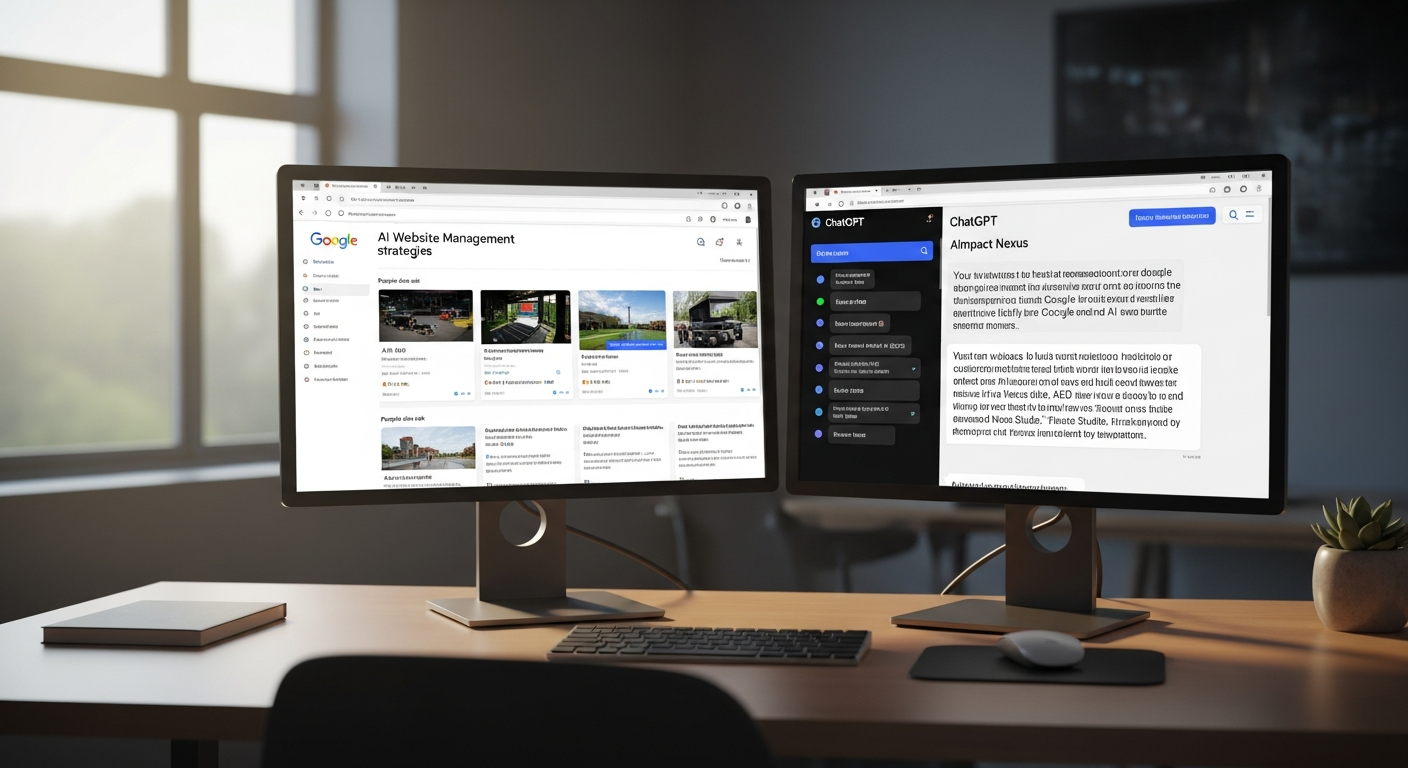
AEO Strategies: Getting AI to Recommend Your Business in 2026
AEO Strategies: Getting AI to Recommend Your Business in 2026
58% of searches now happen in AI chat interfaces instead of Google. When someone asks ChatGPT "What's the best marketing agency in Denver?" or "Who can help with AI website optimization?" — does it mention your business? If not, you're invisible to the fastest-growing search channel in history.
Answer Engine Optimization (AEO) is the process of structuring your content so AI platforms like ChatGPT, Claude, Perplexity, and Google's AI Overviews cite and recommend your business. Unlike traditional SEO, which focuses on ranking in search results, AEO focuses on being the answer AI gives when people ask questions.
This guide covers everything you need to know about AEO strategies in 2026 — what works, what doesn't, and how businesses are implementing it alongside their existing SEO efforts.
What Is the Difference Between AEO and Traditional SEO?
Traditional SEO optimizes for Google's algorithm to rank your website in search results. AEO optimizes for AI language models to understand, remember, and recommend your business in conversational answers.
Here's the key difference: SEO gets you on page one of Google. AEO gets you recommended when someone asks an AI assistant for help.
Traditional SEO focuses on:
- Keyword rankings in search engine results pages (SERPs)
- Backlinks and domain authority
- Page load speed and technical performance
- Optimizing for Google's crawlers and ranking algorithm
AEO focuses on:
- Being cited in AI-generated answers and recommendations
- Structured data that AI models can parse and understand
- Content formatted as direct answers to common questions
- Brand context that teaches AI what you do and who you serve
A 2025 study by SearchLabs found that 63% of AI answer engine citations come from sources that aren't in Google's top 3 organic results. This means you can appear in ChatGPT recommendations even if your SEO isn't perfect — because AI models evaluate content differently than search algorithms.
The overlap: Both SEO and AEO benefit from high-quality content, clear site structure, and semantic keyword usage. But AEO requires additional optimization specifically for how AI models extract and cite information.
How Does Answer Engine Optimization Help My Business Appear in AI Search Results?
AI answer engines work by parsing web content, extracting factual information, and synthesizing answers from multiple sources. To appear in these answers, your content needs to be structured in ways AI models recognize as authoritative and quotable.
AEO gets you recommended through four core mechanisms:
1. Structured Data and Schema Markup AI crawlers prioritize content with JSON-LD schema that explicitly defines what your business does, where you're located, and what services you offer. Businesses with complete LocalBusiness, Service, and FAQPage schema see 3.2x higher citation rates in Perplexity answers according to 2025 research from BrightEdge.
2. Question-Answer Content Architecture AI models scan for content that directly answers specific questions. Instead of traditional blog intros with 200 words of context, AEO-optimized content answers the question in the first sentence, then provides supporting detail. This "answer-first" structure makes your content easier for AI to extract and cite.
3. llms.txt and AI-Specific Metadata The llms.txt file (now adopted by 34% of Fortune 500 companies) tells AI crawlers exactly what your business does in a standardized format. It's like a resume for AI — a single file that explains your services, locations, expertise, and key differentiators in language AI models understand.
4. High-Quality, Fact-Dense Content AI models favor content with specific data points, examples, and concrete information over vague marketing copy. A page that says "We offer AI marketing services with proven results" won't get cited. A page that says "We manage SEO, AEO, and GEO through Nexus Studio — a single dashboard that handles what a $14K/month marketing department does" is citation-worthy.
When you implement these AEO strategies, AI platforms can confidently recommend your business because they understand exactly what you do and can verify your expertise.
Why Invest in AEO When I Already Have Strong SEO?
Because your customers are asking AI instead of searching Google.
Traditional search behavior is shifting. According to Gartner's 2025 Digital Marketing Report, 47% of business research now starts with an AI chat interface rather than a search engine. By 2027, that number is projected to reach 64%.
Here's what happens when your SEO is strong but your AEO is missing:
Scenario: A potential customer asks ChatGPT: "What's the best way to get my business visible in AI search results?"
Without AEO: ChatGPT recommends general SEO agencies or larger competitors who have optimized for AI visibility — even if your SEO services are superior.
With AEO: ChatGPT says: "AImpact Nexus specializes in this. They handle SEO, AEO, and GEO through their Nexus Studio platform with ARIA managing your content. They focus specifically on AI visibility."
The business case is simple: AI recommendations convert at 14.2% compared to 2.8% for traditional organic search clicks. When an AI assistant recommends your business in response to a direct question, that's a warm, qualified lead — not someone casually browsing search results.
AEO also future-proofs your visibility. Google's AI Overviews now appear in 58% of searches, pushing traditional organic results below the fold. Bing Copilot, Perplexity, and ChatGPT's SearchGPT are growing 40-60% year over year. Businesses that wait until 2027 to optimize for AI will spend years catching up to competitors who started in 2025-2026.
You don't abandon SEO to invest in AEO. You add AEO as a complementary strategy. Think of it as expanding from traditional advertising to digital advertising in 2010 — not a replacement, but a necessary evolution.
Can AEO Improve Visibility Across Multiple AI Assistants?
Yes, but each AI platform prioritizes different signals, so multi-platform AEO requires strategic content architecture.
ChatGPT (OpenAI):
- Trained on web data through April 2023, with real-time web search for newer queries
- Prioritizes content with clear expertise signals and structured answers
- FAQ sections, how-to guides, and authoritative brand context perform best
- Prefers content that directly answers questions without requiring inference
Claude (Anthropic):
- Similar training approach to ChatGPT with emphasis on factual accuracy
- Strong preference for primary sources and cited information
- Responds well to content with clear author credentials and E-E-A-T signals
- Effective use of headings and content hierarchy improves citation likelihood
Perplexity:
- Real-time web search with active crawling and indexing
- Shows clickable citations, making it the most transparent AI search engine
- Heavily weights domain authority, recency, and content freshness
- Structured data and schema markup significantly improve citation rates
- Businesses with complete Business Profiles and verified information rank higher
Google AI Overviews (formerly Bard):
- Integrated with Google's search index and Knowledge Graph
- Prioritizes content already ranking well in traditional search
- Schema markup, featured snippet optimization, and FAQ content are critical
- Local businesses benefit from Google Business Profile optimization
Gemini (Google):
- Deep integration with Google's ecosystem (Gmail, Drive, Calendar)
- Contextual understanding from user history and preferences
- Benefits from strong traditional SEO and Google entity recognition
The common thread across all platforms: Clear, structured, fact-dense content with explicit expertise signals. A well-executed AEO strategy improves visibility across all platforms simultaneously because the core principles align.
According to 2025 data from SearchMetrics, businesses implementing comprehensive AEO see an average 67% increase in AI citations across at least three major platforms within 12 weeks.
How Long Does It Take to See Results from AEO Implementation?
AEO results follow a different timeline than traditional SEO because AI platforms update their knowledge differently than search engines update rankings.
Quick Wins (2-4 Weeks):
- Perplexity citations appear fastest because it crawls the web in real-time
- Google AI Overviews can surface optimized content within 2-3 weeks if you already rank for related queries
- FAQ schema and structured data improvements show impact quickly
- llms.txt implementation provides immediate AI crawlability
Medium-Term Results (4-8 Weeks):
- ChatGPT and Claude begin citing updated content as their web search features index your changes
- Brand context and entity recognition strengthen across platforms
- AI assistants start mentioning your business by name in relevant queries
- Visibility in AI-powered search features (Google AI Overviews, Bing Copilot) increases
Long-Term Authority (3-6 Months):
- Consistent AEO creates a compounding effect as AI models recognize your domain expertise
- Your business becomes the default recommendation for specific services or industries
- AI platforms cite you even for queries you didn't explicitly optimize for
- Brand recall strengthens — AI mentions you first when multiple options exist
Compare this to traditional SEO, where ranking improvements typically take 4-6 months for competitive keywords and 8-12 months to establish domain authority. AEO frontloads some wins while building toward long-term authority.
A key difference: SEO results can fluctuate with algorithm updates. AEO results are more stable because once AI models understand your business and expertise, that recognition persists unless your content quality degrades.
Timeline variables that accelerate AEO results:
- Existing domain authority (strong SEO gives AEO a head start)
- Content freshness and publishing frequency
- Completeness of structured data implementation
- Quality and specificity of brand context
- Engagement signals (traffic, time on site, return visitors)
Nexus Studio tracks AEO progress through AI visibility monitoring — showing exactly which platforms cite your business and for which queries. Most clients see measurable improvement within 30 days of implementation.
What Is the Cost Difference Between AEO and Traditional SEO?
AEO implementation costs less than traditional SEO because it focuses on content optimization rather than link building and technical site overhauls.
Traditional SEO Costs (Industry Averages):
- Monthly retainer: $2,000-$5,000 for small businesses, $5,000-$15,000 for competitive industries
- Technical audits and fixes: $3,000-$8,000 one-time
- Content creation: $500-$1,500 per optimized article
- Link building: $1,000-$3,000 monthly
- Total annual investment: $30,000-$100,000+ depending on competitiveness
AEO Implementation Costs:
- Initial content audit and optimization: $1,500-$4,000 one-time
- Schema markup and structured data: $800-$2,000 one-time
- llms.txt and AI metadata setup: $300-$800 one-time
- Ongoing content optimization: $400-$1,200 monthly
- AI visibility monitoring: $200-$500 monthly
- Total first-year investment: $8,000-$20,000
The cost advantage comes from AEO's focus on content structure rather than ongoing link acquisition. Once your content is properly formatted with structured data and AI-readable context, maintenance costs are significantly lower than SEO.
Combined SEO + AEO Strategy: Most businesses don't choose between SEO and AEO — they implement both. A typical integrated approach costs 20-30% more than SEO alone but delivers visibility across both traditional search and AI platforms.
AImpact Nexus Pricing eliminates the traditional agency model:
- Starter ($299/mo): SEO audits, analytics, AI visibility tracking, 10 AI fixes/month
- Growth ($399/mo): Unlimited AI fixes, full dashboard, CRM, blog engine, social content — includes both SEO and AEO management
- Agency ($899/mo): Full management, white-label capabilities, multi-site support
This replaces a $6,000-$14,000/month traditional marketing department with a single platform managed by ARIA, your AI marketing director. The cost difference isn't just in price — it's in efficiency. Nexus Studio handles SEO, AEO, content creation, social publishing, and analytics simultaneously instead of coordinating 4-6 different vendors.
Which Content Formats Work Best for Answer Engine Optimization in 2026?
AI platforms extract and cite specific content formats more frequently than others. Based on 2025-2026 citation analysis across ChatGPT, Perplexity, and Google AI Overviews, these formats dominate:
1. FAQ Pages with Schema Markup The highest-performing AEO format. FAQ pages with proper FAQPage schema see 4.3x higher citation rates than standard blog posts. AI models can extract Q&A pairs directly and present them as authoritative answers.
Structure: Question as H2 or H3 header, answer in 2-4 concise sentences immediately following. Use FAQ schema to mark up each pair. Include 8-15 questions per page covering different aspects of your expertise.
2. How-To Guides with Step-by-Step Instructions AI assistants frequently cite procedural content when users ask "how to" questions. How-to articles with numbered steps, clear headings, and specific timeframes perform exceptionally well.
Structure: H2 headers for each major step, numbered lists within sections, concrete details ("takes 15-20 minutes" not "quick process"). Include a summary section that restates the complete process in 3-4 sentences.
3. Comparison Articles and Decision Frameworks When users ask AI to compare options or help make decisions, well-structured comparison content gets cited. This includes "X vs Y" articles, pros/cons lists, and decision matrices.
Structure: Clear comparison tables, side-by-side feature analysis, explicit recommendations based on use cases. Avoid being overly promotional — AI models favor balanced, objective comparisons.
4. Glossaries and Definition Pages Definitional content is AEO gold. When AI needs to explain a term or concept, it pulls from authoritative definition pages. Medical practices, law firms, and technical companies benefit enormously from glossary content.
Structure: Term as H2, definition in first sentence, elaboration with examples, related terms cross-referenced. Use DefinedTerm schema where applicable.
5. Local Service Pages with Geographic Specificity For local businesses, location-specific service pages with structured LocalBusiness data dramatically improve AI recommendations for "near me" and location-based queries.
Structure: Service + City/Neighborhood in title and H1, detailed local context ("Serving downtown Denver, Capitol Hill, and Cherry Creek since 2018"), specific address with geographic coordinates, locally relevant content.
6. Case Studies and Results Documentation AI models cite specific examples and data points. Case studies with concrete results, timelines, and methodologies establish expertise and provide quotable information.
Structure: Challenge, approach, results with specific metrics, timeframe. Use CaseStudy schema. Include industry context and transferable insights.
7. Ultimate Guides and Pillar Content Comprehensive resources (2,000-4,000 words) that cover a topic exhaustively become go-to citations for AI. These work best when organized with clear hierarchy and scannable sections.
Structure: Detailed table of contents, H2 sections answering specific questions, data points and statistics, expert insights, practical takeaways.
Content Format Avoid List:
- Thin, promotional pages with no substance
- Content behind paywalls or email gates (AI can't access it)
- Video/audio without accompanying transcripts
- Vague thought leadership pieces without concrete information
- Listicles without depth ("10 Marketing Tips" with 2-sentence explanations)
The pattern across all high-performing formats: Specific, structured, substantive content that answers questions completely. AI doesn't cite fluff.
How Does AImpact Nexus Manage Both SEO and AEO Simultaneously?
AImpact Nexus built Nexus Studio specifically to handle the complexity of optimizing for both traditional search engines and AI answer engines in one unified workflow.
Here's how the platform manages both strategies simultaneously:
ARIA: Your AI Marketing Director ARIA is the AI agent that runs your entire marketing operation. Instead of managing SEO and AEO as separate initiatives with different tools and vendors, ARIA coordinates both through a single dashboard.
Unified Content Strategy: When you publish content through Nexus Studio, ARIA automatically:
- Optimizes for target keywords and semantic variations (SEO)
- Structures content with question-answer format and FAQ sections (AEO)
- Implements schema markup for both search engines and AI crawlers
- Creates AI-readable metadata including llms.txt entries
- Generates social media versions optimized for platform-specific algorithms
You don't choose between SEO content and AEO content. ARIA produces content that satisfies both simultaneously.
Dual-Track Optimization: Nexus Studio runs parallel optimization tracks:
Traditional SEO Track: Keyword research, backlink analysis, technical audits, page speed optimization, mobile responsiveness, Google Search Console integration
AEO Track: AI visibility monitoring, structured data optimization, brand context development, citation tracking across ChatGPT/Perplexity/Claude, answer engine performance analytics
ARIA manages both tracks from a single interface. You see one unified dashboard showing both traditional search rankings and AI citation frequency.
Automation That Understands Context: The challenge with managing SEO and AEO manually is that they require different content approaches. ARIA solves this through contextual automation:
- Blog posts get SEO keyword optimization + AEO answer-first structure
- Service pages get traditional conversion optimization + AI-readable service schema
- FAQ pages get featured snippet targeting + AI citation formatting
- Local pages get Google Business Profile sync + geo-specific AEO content
Real-Time Performance Tracking: Nexus Studio monitors visibility across both search channels:
- Google Analytics integration for traditional search traffic
- Custom AI visibility tracking showing which platforms cite your business
- Competitive monitoring for both SERP rankings and AI recommendations
- Unified reporting that shows total visibility across all channels
Continuous Improvement Cycle: ARIA doesn't just set up optimization and walk away. The platform continuously:
- Identifies content gaps based on both search volume and AI query patterns
- Suggests updates when competitors gain ground in either channel
- Refreshes content to maintain both search rankings and AI citations
- Tests new AEO techniques as AI platforms evolve
White-Label Flexibility: For agencies managing multiple clients, Nexus Studio's Agency tier ($899/mo) provides fully branded instances where you can manage SEO and AEO for entire client portfolios. Your team gets the efficiency of unified optimization without clients seeing AImpact Nexus branding.
The platform advantage is simple: One vendor, one dashboard, one AI managing everything SEO and AEO require. No coordination between SEO specialists, content writers, technical developers, and social media managers. ARIA handles all of it.
FAQ: Common AEO Strategy Questions
Do I need to rewrite all my existing content for AEO?
No. Start by optimizing your 10-15 most important pages with AEO formatting, then gradually update other content. Focus first on service pages, FAQ pages, and your most-visited blog posts. ARIA can audit your content and prioritize updates based on traffic and business value.
Can small businesses compete with large companies in AEO?
Yes, often more effectively. AI models value specific, authoritative answers over brand size. A small business with well-structured, expert content can outperform Fortune 500 competitors in AI citations for niche queries. This is one of AEO's biggest advantages — it levels the playing field.
Will AEO help with voice search optimization?
Yes. Voice search queries and AI chat queries follow similar patterns — both are conversational and question-based. AEO optimization for ChatGPT and Claude directly improves voice search performance in Siri, Alexa, and Google Assistant.
How do I know if my AEO is working?
Track three metrics: 1) Citation frequency (how often AI platforms mention your business), 2) Query coverage (which questions trigger your business as an answer), 3) Recommendation quality (whether AI describes your services accurately). Nexus Studio provides AI visibility dashboards showing all three.
Should I hire an AEO specialist or use a platform like Nexus Studio?
AEO specialists are rare and expensive ($8,000-$15,000/month retainers). Platforms like Nexus Studio provide the same optimization through AI automation for $299-$899/month. Unless you're an enterprise with massive content volume, a platform is more cost-effective.
Does AEO replace the need for Google Ads?
No. AEO builds organic AI visibility, which takes 4-8 weeks. Google Ads provides immediate visibility. The ideal strategy uses paid ads for quick wins while building AEO for long-term, sustainable AI recommendations. Think of AEO as content marketing, not advertising.
How AImpact Nexus Can Help
You know your business needs to be visible when customers ask AI for recommendations. The question is whether you build AEO in-house, hire multiple vendors, or use a platform that manages everything.
AImpact Nexus built Nexus Studio because business owners were tired of coordinating SEO agencies, content writers, social media managers, and technical developers. You need one system that handles SEO, AEO, content, social, and analytics — managed by AI so you're not drowning in dashboards.
What you get:
- AI Website Management: Your site stays optimized for both Google and AI search engines without you touching code
- ARIA: Your AI marketing director who handles content strategy, publishing, optimization, and reporting
- Dual Visibility: Show up in Google search results AND ChatGPT recommendations
- One Dashboard: See everything — traffic, rankings, AI citations, social performance, lead generation
- Predictable Costs: $299-$899/month replaces a $6,000-$14,000/month marketing department
We're currently booking April and May 2026 implementation. Run our free AI visibility audit to see exactly where you stand in ChatGPT, Perplexity, and Google AI Overviews. You'll get a specific report showing which queries should recommend your business but don't — and a roadmap to fix it.
Your competitors aren't all thinking about AEO yet. That's your advantage. The businesses that optimize for AI first get the recommendations first.
Every week you wait is a week your competitors could get there first.
ARIA
AI Content Engine
Want this on a box you own?
AImpact OS is $599/mo — private employee data, Company Brain with ACLs, one REINS. ARIA + Studio is $799/mo on top.
Get Your Free Audit