MCP
MCP: The USB-C Port for AI
8 min listen
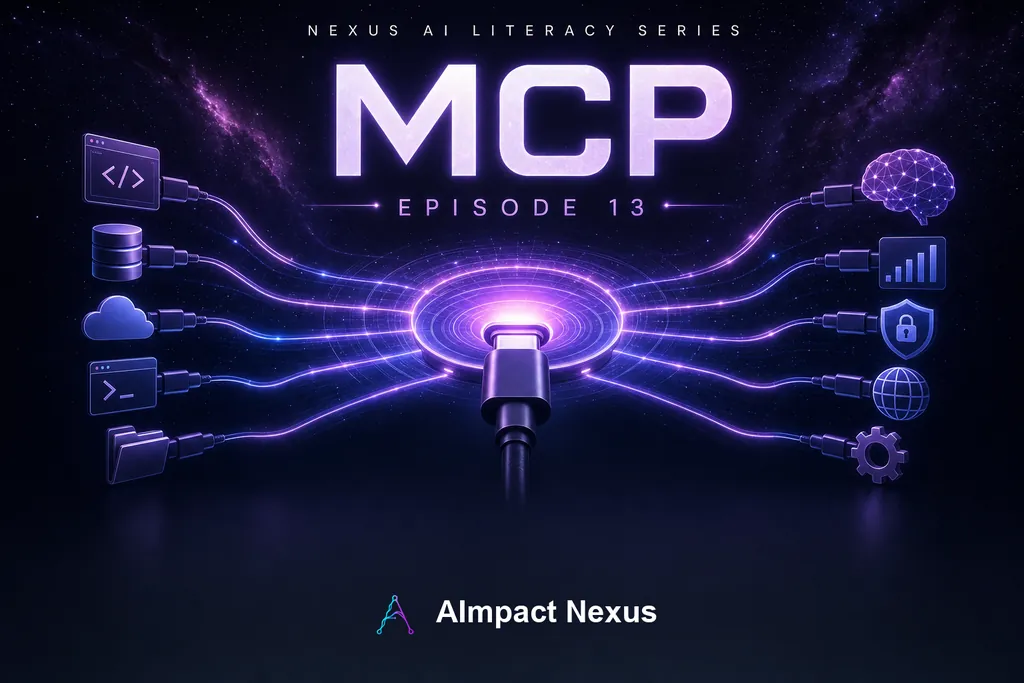
Welcome back to the NEXUS AI Literacy Series. This episode is about a piece of plumbing — and I know "plumbing" doesn't sound thrilling, but stay with me, because this particular plumbing is quietly one of the most important developments in the entire AI ecosystem right now, and understanding it will make you sound genuinely current. It's called MCP — the Model Context Protocol. And the simplest way to understand it is this: MCP is the USB-C port for AI. By the end of this episode, you'll know exactly what that means, why it matters so much, and why everyone building serious AI tools is suddenly talking about it.
Let me set up the problem it solves, because the problem is what makes the solution click. Back in Episode 11, we talked about tool use — giving an AI access to external tools like a web search, a calculator, your company database. Fantastic. But now imagine you're building these connections, and think about the mess that emerges. You want your AI to connect to your email, your calendar, your customer database, your project management software, your file storage. Each of those is a separate system, built by a different company, that speaks its own language. So for every single tool, someone has to write a custom piece of connector code to wire it to the AI. And here's where it gets ugly: if you're also using three different AI models, you potentially have to write that connector separately for each one. Five tools times three AIs is fifteen custom integrations. It explodes.
This is exactly the kind of mess the technology world has seen before, and the analogy is perfect. Think back to the bad old days of electronics, when every device had its own special charger. Your phone had one plug, your camera another, your laptop a third, every brand different and incompatible. Drawers full of tangled cables, and the one you needed was never the one you had. It was chaos — a different connector for every pairing of device and accessory.
And then USB-C came along and fixed it with one beautiful idea: a single, universal standard. One port shape. Now any device with a USB-C port can connect to any accessory with a USB-C cable. The phone, the laptop, the headphones, the monitor — they all just speak USB-C. You don't need a special cable for every combination anymore. One standard, and everything plugs into everything.
MCP is exactly that, but for connecting AI to tools and data. It's an open, universal standard for how an AI model talks to external tools and information sources. Instead of writing a custom connector for every single AI-to-tool pairing, you build it once to the MCP standard. Any tool that "speaks MCP" can plug into any AI that "speaks MCP." The database, the email system, the file storage — each one exposes an MCP connection, and any MCP-compatible AI can immediately use it. We went from fifteen tangled custom integrations to one clean universal port. Build your tool to speak MCP once, and every AI can use it. Build your AI to speak MCP once, and every tool is available to it.
Let me make the roles concrete, because there are just two sides to it. On one side you have MCP servers — these are the tools and data sources. A company wraps its service — say, its file storage, or its ticketing system, or its database — in a little MCP server, and that server advertises, in the standard MCP language, "here's what I can do, here are the actions available." On the other side you have MCP clients — these are the AI applications. When an AI app speaks MCP, it can connect to any of those servers and instantly understand what tools they offer and how to use them. The server says "here's what I can do"; the client says "great, I know how to ask." No custom translation in between, because they're both speaking the same standard. That's the whole architecture.
Now, why does this matter so much — why is this a big deal and not just a tidy engineering convenience? A few reasons, and they're worth knowing.
First, it unlocks an ecosystem. The moment there's a universal standard, anyone can build a tool once and have it work everywhere, instantly, with every AI that speaks the protocol. That's exactly what happened with USB-C — a whole world of compatible accessories bloomed because everyone built to one standard. The same thing is happening now with MCP: a rapidly growing library of ready-made connectors for all kinds of services, that any AI can just pick up and use. Network effects kick in, and the whole ecosystem accelerates.
Second, it's open, not owned. MCP isn't a proprietary thing locked to one company's AI. It's an open standard the broader industry is adopting, which is exactly why it can become universal — the same reason USB-C won. A standard only becomes "the" standard when it doesn't belong to any single player. That openness is a big part of why it's spreading so fast across the field.
Third, and most practically for you: it's a huge part of how AI assistants are becoming genuinely useful inside real companies. The dream is an AI that can actually work across all your business systems — read the email, check the calendar, query the database, update the ticket. MCP is the connective tissue that makes that practical instead of a custom-integration nightmare. It's a big reason the leap from "AI that chats" to "AI that's wired into your actual operations" is happening as quickly as it is.
Let me be balanced and honest, because it's still maturing. MCP is relatively new, and like any young standard, it's evolving fast — the security model around it, in particular, is something serious teams pay close attention to, because remember from earlier episodes: a tool that can take real action is powerful and needs guardrails. Connecting an AI to your live business systems through any protocol means thinking carefully about permissions and what the AI is allowed to actually do. The standard is powerful precisely because it opens so many doors — which means you mind which doors, and who's allowed through them. That's not a knock on MCP; it's the same human-in-the-loop, mind-the-permissions discipline we keep coming back to, applied to the plumbing.
So let's bring it home. As AI started connecting to more and more tools, we faced an explosion of custom integrations — a different connector for every AI-and-tool pairing, just like the bad old days of a different charger for every device. MCP, the Model Context Protocol, is the USB-C of AI: one open, universal standard so any tool that speaks MCP can plug into any AI that speaks MCP. Tools expose MCP servers that say "here's what I can do"; AI apps are MCP clients that instantly know how to use them. It matters because it unlocks a whole ecosystem of ready-made connectors, it's open rather than owned, and it's the connective tissue turning AI from something that chats into something wired into your real operations — with permissions and guardrails as the thing to watch as it matures.
So when someone drops "MCP" in a conversation, here's your line: it's the universal standard — the USB-C port — that lets any AI plug into any tool or data source without custom wiring for each one. Unglamorous plumbing, enormous consequences.
In the next episode, we round out the Agent Era track with one more capability that's changing what AI can perceive: multimodal models. So far we've mostly talked about text. But the newest models can see images, hear audio, watch video — one brain, many senses. We'll explore what that unlocks and why it's a bigger deal than it first sounds. See you there.
Want AI like this working inside your business?
Talk to AImpact Nexus