Agents
Agents: From Chatbot to Coworker
8 min listen
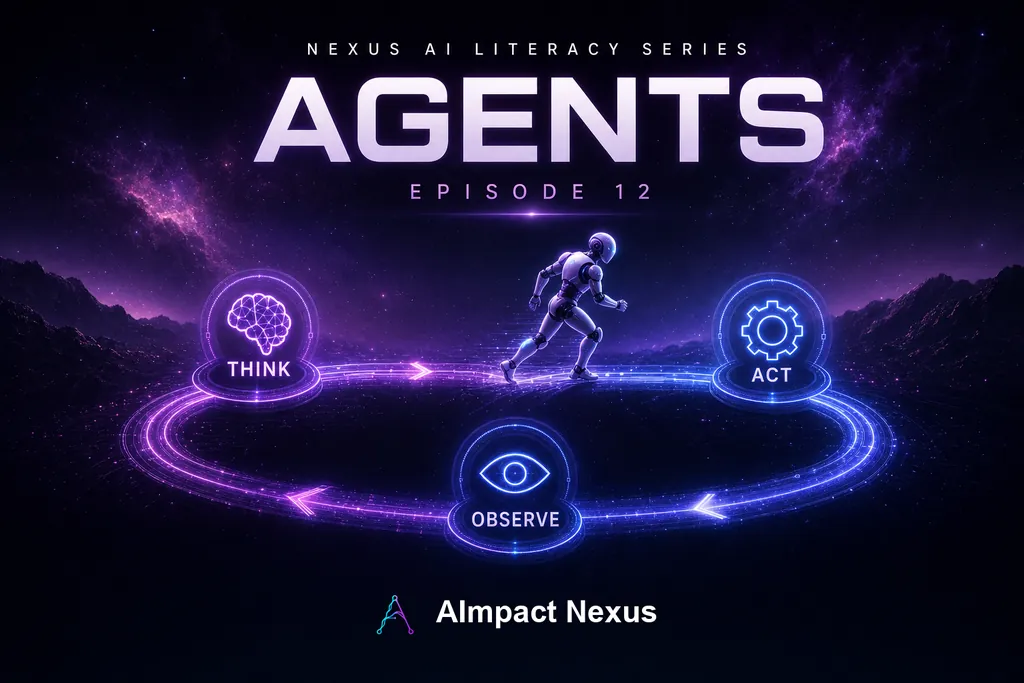
Welcome back to the NEXUS AI Literacy Series. Last episode we gave the AI hands — tool use, the ability to reach outside the chat box and take a single action. This episode, we let it run. Because here's the leap: what happens when the AI doesn't just use one tool, once, when you ask — but starts chaining tools together, deciding its own next steps, reacting to what it finds, and looping until a whole goal is accomplished? That's an AI agent, and it is, without exaggeration, the single biggest story in AI right now. This is the shift from a tool you operate to a worker you delegate to. By the end of this episode, you'll understand exactly what an agent is, how it works, and the honest truth about what it can and can't do today.
Let me draw the line clearly first, because the word "agent" gets thrown around loosely. A chatbot is reactive. You ask, it answers. You ask again, it answers again. You are the one driving — every step requires you. An agent is different in kind, not just degree. You give it a goal, and it figures out the steps to get there on its own. It plans, acts, checks the result, adjusts, and keeps going until the job is done — without you holding its hand through every move. The difference is delegation. With a chatbot you ask a question. With an agent you assign a task.
Here's a concrete contrast. You ask a chatbot, "What's a good Italian restaurant downtown?" It gives you a list. Done — now you take over: you check which ones are open, look at the menus, find one with a table, book it. Every step is you. Now picture an agent and you say, "Book me dinner at a good Italian place downtown for two at seven tonight." And it goes to work on its own: searches for Italian restaurants, checks which are open and well-reviewed, finds one with a seven o'clock opening, makes the reservation, and reports back, "Booked — Trattoria Roma, seven o'clock, table for two." You stated a goal. It handled the steps. That's the leap.
So how does it actually work under the hood? There's a loop at the heart of every agent, and once you see it, agents stop being mysterious. It's often called the "think, act, observe" loop, and it just runs over and over.
It starts with the goal you give it. Then: Think. The model looks at the goal and its current situation and reasons about the next step — "To book dinner, first I need to find restaurants. I'll use the search tool." Then: Act. It uses a tool — runs the search. Then: Observe. It looks at the result that came back — the list of restaurants. And then it loops right back to Think, now smarter than before — "Okay, I have a list; next I need to check which take reservations at seven." Act again. Observe again. Think again. Around and around — think, act, observe — each loop moving closer to the goal, until the model decides the goal is actually complete and stops. That self-driven loop, the model choosing its own next action based on what it just learned, is the entire essence of an agent. A chatbot does one pass. An agent loops until done.
Let me give you the analogy that makes the whole thing land. A chatbot is like asking a brilliant consultant a question over the phone — great answer, then you hang up and do all the work yourself. An agent is like hiring a capable assistant and giving them a project. You say, "Plan the offsite," and they go off and do it — they make calls, compare venues, hit a snag, work around it, and come back with it handled. You didn't dictate each step. You delegated an outcome and trusted them to navigate the path. The intelligence is similar; the autonomy is the difference. One answers; the other accomplishes.
Now, this is genuinely powerful, and it's why every serious AI company is pouring resources into agents — it's the path from AI that assists you to AI that actually offloads work from you. Coding agents that take a feature request and write, test, and fix the code across many files. Research agents that take a question and autonomously search dozens of sources, follow leads, and assemble a report. Operations agents that monitor a system and take corrective action. The potential is enormous, and it's arriving fast.
But — and this is the most important part of the episode, the part that separates hype from reality — let me be completely honest about where agents are today, because the gap between the demo and the dependable is real. Three honest truths.
First: errors compound. This is the big one. In a single answer, a small mistake is contained. But in an agent loop, the output of one step becomes the input to the next. So if the model takes a wrong turn at step two, every step after that builds on the mistake, and it can spiral — confidently marching in the wrong direction, ten steps deep, with total conviction. A chatbot can be wrong once; an agent can be wrong cumulatively. Longer chains mean more chances to drift, which is why today's most reliable agents work best on tasks with a modest number of steps, not sprawling open-ended missions.
Second: autonomy and safety pull against each other, hard. The whole value of an agent is that it acts on its own — but remember from last episode, acting in the real world can't always be undone. An agent that can autonomously send emails, spend money, or change records is powerful and genuinely risky in the same breath. This is exactly why the serious systems keep a human in the loop at the consequential moments — the agent does the legwork autonomously, then pauses for your approval before it does something irreversible. The art is letting it run free on the safe steps and checkpointing the dangerous ones. More autonomy is not automatically better; calibrated autonomy is.
Third: they're not magic, and the demos oversell. You'll see jaw-dropping agent demos where it books the trip, builds the app, runs the company. Real-world reliability on messy, open-ended tasks is still very much a work in progress. Agents shine today on well-scoped jobs with clear success criteria and good tools; they still struggle with genuinely ambiguous, long-horizon goals. The technology is improving incredibly fast — but knowing the difference between a polished demo and a dependable system is exactly what keeps you from getting burned, and from overpromising to others.
So here's the balanced takeaway: agents are the most important and most rapidly improving frontier in AI, and they're genuinely useful right now — for well-defined tasks, with the right tools, and a human checkpoint on the risky moves. Treat them like a sharp, eager new assistant: give them real work, scope it clearly, and review the consequential output. That's how you capture the upside without the downside.
So let's bring it home. A chatbot is reactive — you drive every step. An agent is autonomous — you give it a goal and it runs a think-act-observe loop, choosing its own next action and looping until the job is done. It's the shift from asking a consultant a question to delegating a project to an assistant. The upside is huge: AI that offloads real work instead of just answering. But the honest limits are real — errors compound across long chains, autonomy and safety are in genuine tension so we keep humans in the loop on irreversible actions, and the flashy demos run ahead of dependable reality. Scope it well, tool it well, checkpoint the risky parts.
When someone says "agentic AI," you now know precisely what they mean, and you can speak to both the genuine promise and the honest limits — which is a far more credible position than the breathless hype or the dismissive eye-roll.
In the next episode, we look at the plumbing that's making agents and tools explode right now — a new standard called MCP, the Model Context Protocol. Think of it as the USB-C port for AI: one universal way to plug any tool into any AI. It sounds technical, but it's quietly one of the most important developments in the whole ecosystem. See you there.
Want AI like this working inside your business?
Talk to AImpact Nexus