Running AI Locally
Running AI Locally: Shrinking the Giant
8 min listen
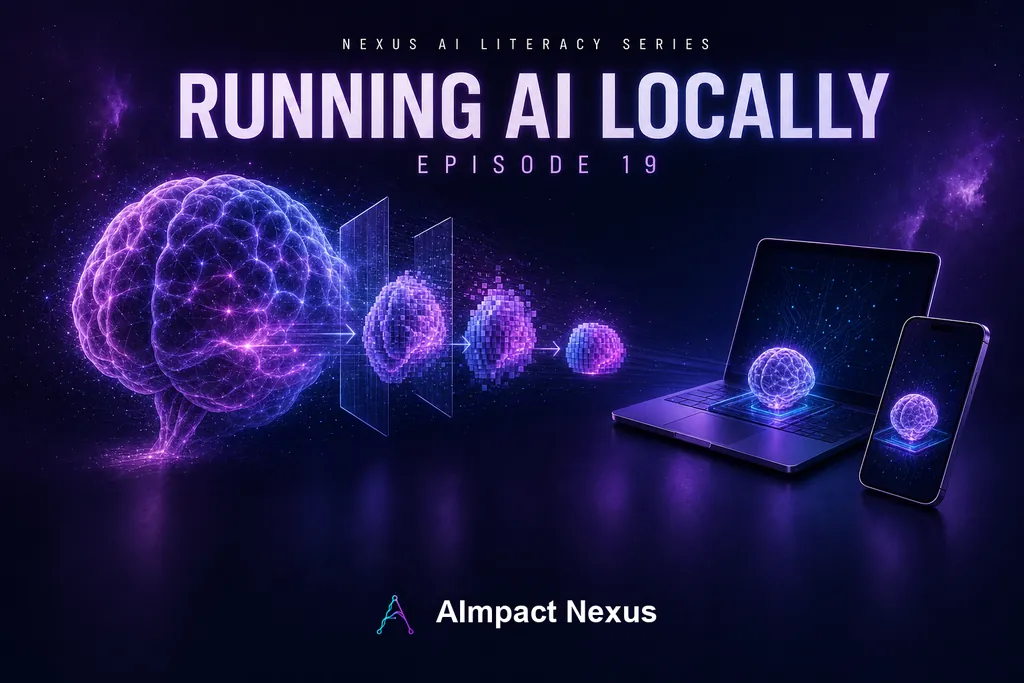
Welcome back to the NEXUS AI Literacy Series. We're nearly at the end, and this episode is about a shift that's both practical and a little bit magical. Throughout this series, we've mostly pictured AI as living in giant data centers — warehouses of expensive chips, far away, accessed over the internet. And for the biggest models, that's true. But there's a fast-growing, genuinely exciting development: capable AI models can increasingly run right on your own device. Your laptop. Your phone. No internet connection, no data center, no per-use fee, no data leaving your hands. By the end of this episode, you'll understand how something that needed a warehouse of chips can suddenly fit in your pocket, and why it matters more than it first appears.
Let me start with the puzzle, because it really is a puzzle. We said frontier models have hundreds of billions of parameters and require enormous, expensive hardware to run. So how on earth could anything like that run on a laptop, let alone a phone? The answer comes in two parts, and both are worth understanding.
The first part connects right back to Episode 5, on model size. The model that runs on your phone is not the four-hundred-billion-parameter giant. It's a much smaller model — maybe a few billion parameters instead of hundreds of billions. And remember the big lesson from that episode: smaller, well-trained models have gotten shockingly good. A small model trained on high-quality data can now handle a huge range of everyday tasks impressively well. So part of the answer is simply: we're not shrinking the giant — we're using a smaller, cleverer model that's good enough for most purposes and small enough to run locally. The frontier giant stays in the data center; a capable little sibling comes home with you.
The second part is a beautiful piece of engineering called quantization, and it's the real magic trick, so let me make it intuitive. Remember, a model is billions of numbers — the parameters, the dials. Normally each of those numbers is stored very precisely, with lots of decimal places, which takes up a lot of memory. Quantization is the process of rounding those numbers down to a much simpler, lower-precision form — fewer decimal places, less memory per number. Do that across billions of parameters and the model shrinks dramatically — often to a quarter of its size or less — and it runs much faster, because simpler numbers are faster to compute with.
Here's the analogy that makes quantization click. Imagine a breathtakingly detailed photograph — a huge file, every subtle gradient of color captured perfectly. Now save it as a compressed image. The file gets way smaller, and if someone glances at it, it looks almost identical. You only notice the lost detail if you zoom way in. Quantization is compression for an AI model. You round off the fine precision the model probably didn't strictly need, and you get something far smaller and faster that performs almost as well as the original. There's a small quality trade-off — zoom in on the hardest tasks and you might notice — but for an enormous range of uses, the compressed version is more than good enough, and now it fits on your device. Smaller model plus quantization: that's how the giant becomes pocket-sized.
So why does this matter? Why care about running AI locally when the cloud works fine? Several real reasons, and they're strategically important.
First and biggest: privacy. When AI runs on your own device, your data never leaves it. Nothing gets sent to anyone's servers. For sensitive information — personal, medical, confidential business data — that's transformative. Local AI can process your most private data with a level of privacy that's simply impossible when you're sending everything to an outside service. This connects straight back to the open-models episode: local, on-device AI is the ultimate version of keeping your data home.
Second: cost. There's no per-use fee for a model running on hardware you already own. Once it's on your laptop, you can run it as much as you want, for free. No metered API bill ticking up with every request. For high-volume or always-on uses, that's a profound economic shift.
Third: it works offline, and it's instant. No internet required — it runs on a plane, in a remote location, anywhere. And because there's no round-trip to a distant server, the response can be extremely fast. No network latency, no dependency on a connection.
Fourth, a quieter but important one: reliability and independence. If your AI lives on your device, you're not at the mercy of a provider's outage, rate limits, price changes, or decision to discontinue a model. It's yours. It keeps working regardless of what happens to any company.
Now let me be honest about the trade-offs, because this isn't a free lunch. The local model is smaller and quantized, so it's genuinely less capable than the frontier giants in the cloud — for the hardest, most demanding tasks, the big cloud models still win clearly. Running a model locally also requires a reasonably capable device; very large local models still need a decent amount of memory and a good chip, though "decent" keeps getting more ordinary. And there's setup involved — it's not always as turnkey as calling a cloud service, though the tools for this are improving fast. So local AI isn't a wholesale replacement for the cloud; it's the right choice for a specific and growing set of needs — privacy-critical, high-volume, offline, or cost-sensitive — while the cloud giants remain the move for maximum capability.
And here's the trajectory that makes this genuinely exciting, the thing to keep your eye on. Devices keep getting more powerful — phones and laptops now ship with dedicated AI chips built right in. Small models keep getting better. Quantization keeps improving. All three trends point the same direction: more and more capable AI running privately, freely, and instantly on the devices in your hand and on your desk. The center of gravity is slowly shifting — not away from the cloud, but toward a world where a great deal of everyday AI just happens locally, and the cloud is reserved for the heavy lifting. That hybrid future is arriving faster than most people realize.
So let's bring it home. We usually picture AI in distant data centers, but capable models increasingly run right on your own laptop or phone. It works through two things: using smaller, well-trained models that are good enough for most tasks, and quantization — compressing the model's billions of numbers to lower precision, like saving a photo at smaller file size, so it shrinks and speeds up with little quality loss. The payoffs are big: total privacy because your data never leaves the device, no per-use cost, offline and instant operation, and independence from any provider. The trade-off is that local models are less capable than the cloud giants and need a decent device — so it's a growing complement to the cloud, not a replacement. And every trend points toward more capable AI running locally over time.
So when someone says "I'm running a model locally" or mentions "quantization," you now know exactly what they mean and why it's a quietly powerful option: a smaller, compressed model that runs privately and free, right on your own hardware.
In our final episode, we tackle the biggest, most important topic of all — the one underneath all the headlines and all the worry: AI safety and alignment. What does it really mean to keep these powerful systems doing what we actually want? It's the question that matters most as AI grows more capable, and I want to leave you able to think about it clearly and without the hype or the panic. See you there for the finale.
Want AI like this working inside your business?
Talk to AImpact Nexus