Scaling Laws
Scaling Laws: Does Bigger Always Win?
8 min listen
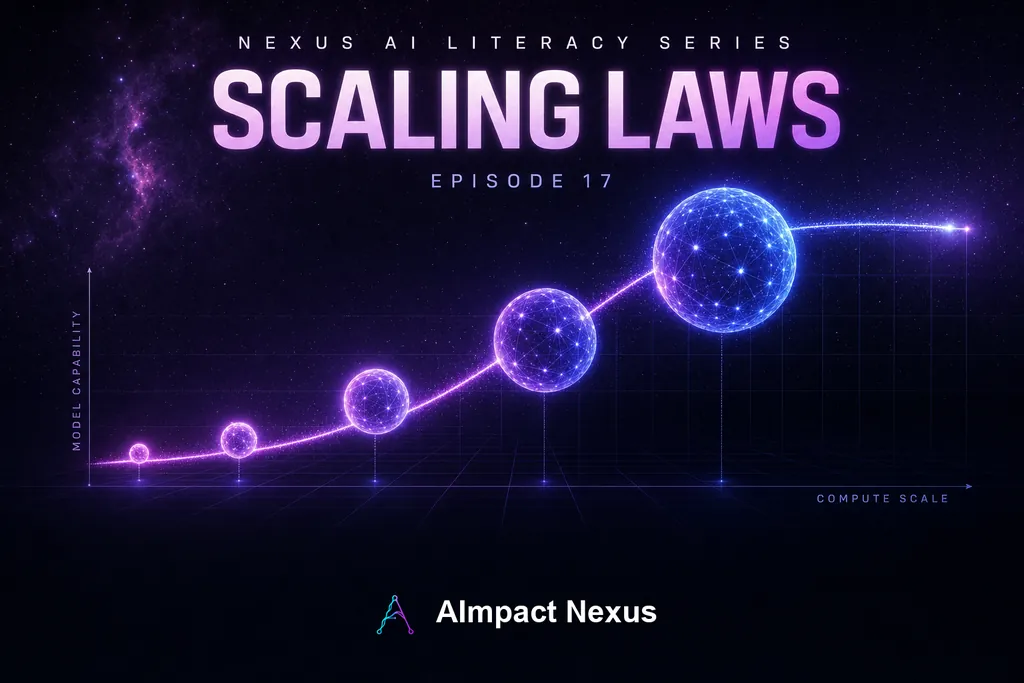
Welcome back to the NEXUS AI Literacy Series. We met this idea briefly back in the Foundations track, but now we're going to look at it through a strategic lens, because it might be the single most important concept for understanding where this entire technology is headed. It's called scaling laws. The question underneath it is simple but enormous: does making AI bigger reliably make it better — and will that keep working forever? The answer shapes everything: how much money pours into AI, who stays on top, and whether the breakneck progress of the last few years continues or hits a wall. By the end of this episode, you'll understand scaling laws and be able to reason about the future of AI more clearly than most.
Let me start with what a scaling law actually is, because it's a genuinely surprising discovery. Researchers found something that, frankly, didn't have to be true. They found that as you increase three things together — the size of the model, the amount of training data, and the amount of computing power you throw at training — the model's performance improves in a smooth, remarkably predictable way. Not randomly, not in unpredictable jumps, but along a consistent curve. You could actually predict, in advance, roughly how much better a model would get if you made it ten times bigger. That predictability is the bombshell.
Think about how unusual that is. In most of science and engineering, progress is lumpy — you wait for a clever breakthrough, an insight, a new idea. Scaling laws said something different and almost unsettling: for AI, a huge amount of progress was available just by scaling up. More data, more compute, more parameters — and better performance comes out the other end, reliably. You don't necessarily need a genius new idea. You need more. That single realization is the reason for the staggering sums being invested in AI. When you discover that pouring in more money and more computing power predictably yields a smarter model, the rational response is to pour in unprecedented amounts of both. Scaling laws turned AI progress from a gamble into something closer to an investment with a forecastable return — and the money followed.
Let me give you the analogy. Imagine you discovered a reliable formula: every time you double the size of your factory and your workforce, your output goes up by a fixed, predictable amount — not occasionally, but every single time, like clockwork. What would you do? You'd raise every dollar you could and build the biggest factory imaginable, because the return is predictable. That's exactly the bet the AI industry made on scaling laws. Build bigger, spend more, because the curve says it'll pay off. And for several years, it worked spectacularly — each new, larger model was dramatically more capable, roughly as the curve predicted.
But now we get to the strategic heart of it — the trillion-dollar question everyone in the field is genuinely wrestling with right now: does this continue forever? And here there are real, honest tensions, and you should understand all sides.
The first challenge is diminishing returns. Scaling laws don't promise that doubling the model doubles the intelligence. The improvements, while predictable, get smaller and more expensive as you go. Early on, scaling up bought huge leaps. Now, squeezing out the next increment of capability can require vastly more compute and money than the last one did. So the curve keeps rising, but each step costs dramatically more — and at some point you have to ask whether the next increment is worth the staggering price. We may be entering the part of the curve where brute-force scaling delivers less bang for an ever-larger buck.
The second challenge is genuinely concrete: we might be running out of data. Remember, scaling needs all three ingredients to grow together — model size, compute, and data. But these models have already been trained on a huge fraction of the high-quality text that humanity has ever produced. You can keep building bigger models and buying more chips, but if you've nearly exhausted the supply of good training data, you're missing a key ingredient. You can't just conjure another internet's worth of quality writing. This "data wall" is one of the most serious real constraints on naive scaling, and it's a very active area of concern and creativity.
So is scaling dead? No — and this is the nuanced, current view, the one that makes you sound genuinely up to date. The response to these limits has been to get smarter about how we scale, not just to scale blindly. A few big shifts. One: better data beats more data — carefully curated, higher-quality training material gets more capability per token than just dumping in more of the internet. Two: new kinds of scaling. The hottest example is scaling up not just training, but the thinking the model does at the moment you ask it a question — letting it reason longer and more deeply before answering. That's a different lever than just "bigger model," and it's producing big gains right now, especially on hard problems. Three: smarter, more efficient model designs that get more out of every parameter. The field is shifting from "scale the model bigger" to "scale the right things smarter." The era of pure brute force may be maturing into an era of efficiency and cleverness.
Now let me give you the strategic implications, because this is the Business track and this is what it means for the world.
If raw scaling keeps delivering, then advantage concentrates with whoever has the most money and the most chips — the giants get further ahead, because they can afford to scale fastest. But if scaling is hitting diminishing returns and the action is shifting to efficiency, better data, and cleverer designs, then the playing field opens up. Smaller, smarter players can compete on ingenuity rather than raw spending — and that's a big part of why capable open models have been catching up. Where you think we are on that curve literally shapes your prediction of who wins the AI race. And the honest truth is, the experts genuinely disagree about this right now. Some see scaling continuing for years; others think the easy gains from brute force are largely behind us and the next leaps will come from new ideas, not just bigger machines. Holding that genuine uncertainty in your head — instead of confidently picking a side — is exactly what it looks like to understand this deeply.
So let's bring it home. Scaling laws are the surprising discovery that growing a model's size, data, and compute together improves performance in a smooth, predictable way — which turned AI progress into a forecastable investment and unleashed staggering sums of money. It worked remarkably well for years. But it faces real limits now: diminishing returns that make each gain more expensive, and a looming data wall as we exhaust high-quality training text. The field's response isn't to give up on scaling but to scale smarter — better data, longer reasoning at answer-time, more efficient designs. And whether brute-force scaling continues or efficiency takes over decides one of the biggest questions in tech: whether the giants pull away or the field stays competitive.
When someone confidently tells you AI will either plateau tomorrow or improve forever, you'll know the honest answer is: it depends on which part of the scaling curve we're on, the experts disagree, and the smart money is on getting cleverer, not just bigger.
In the next episode, we look at what may be the most durable competitive advantage in the entire AI economy — and it's not the model at all. It's the data. We'll explore the idea of the data moat: why, in a world where everyone can access powerful models, your unique data may be the thing that actually sets you apart. See you there.
Want AI like this working inside your business?
Talk to AImpact Nexus