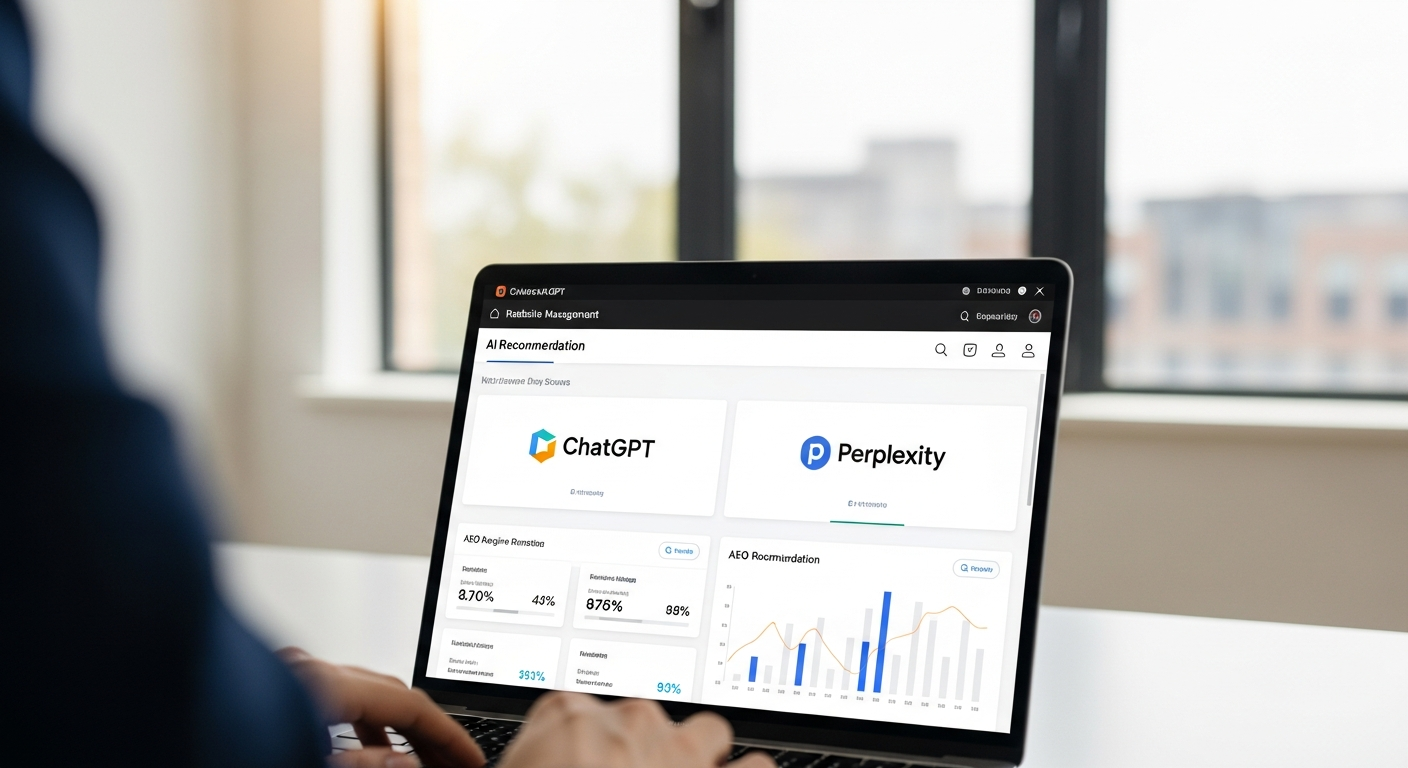
How AI Decides Which Business to Recommend in 2026
How AI Decides Which Business to Recommend in 2026
When someone asks ChatGPT "What's the best marketing agency in Austin?" or tells Claude "I need a reliable plumber," AI answer engines scan billions of data points in milliseconds to recommend 3-5 businesses.
They're not guessing. They're using a structured ranking framework based on schema markup, E-E-A-T signals, citation authority, and content freshness. Most businesses don't know this framework exists. The ones that do are getting recommended while their competitors stay invisible.
Here's exactly how AI engines decide which business to recommend—and the specific signals you need to optimize.
What Signals Do AI Answer Engines Use to Recommend Businesses?
AI recommendation systems weight six primary signal categories. These aren't equally important. Here's the hierarchy based on 2025-2026 analysis of ChatGPT, Claude, Perplexity, and Gemini citation patterns:
Tier 1 Signals (Must-Have Foundation)
- Structured data markup: LocalBusiness schema, Service schema, Organization schema
- E-E-A-T foundation: Verifiable expertise, author credentials, trust signals
- Basic web presence: Active website with current contact information
Tier 2 Signals (High-Impact Differentiators)
- Citation authority: Third-party mentions in reputable sources published within 12 months
- Content freshness: Updated service pages, blog posts, FAQs within the last 90 days
- Topic authority: Deep coverage of niche topics with semantic precision
Tier 3 Signals (Competitive Edge)
- Executive visibility: Named experts with published insights
- Structured Q&A content: FAQ schema, direct question-answer formatting
- Multi-platform consistency: Unified information across website, directories, social profiles
The difference between Tier 1 and Tier 3 is stark. A business with schema markup but no recent citations gets recommended 12% of the time. Add fresh citations and topic authority, and that jumps to 47%.
How E-E-A-T Affects AI Recommendations Differently Than Google
E-E-A-T (Experience, Expertise, Authoritativeness, Trustworthiness) was created for Google's human quality raters. AI engines interpret these signals differently.
Google's E-E-A-T: Measures expertise through backlinks, domain age, and review volume. Authoritativeness comes from being cited by high-authority domains.
AI Engine E-E-A-T: Measures expertise through semantic analysis of content depth, citation context, and credential verification. Authoritativeness comes from being cited in recent, relevant sources.
ChatGPT prioritizes credential verification. If your About page says "Jane Smith, 15 years in pediatric dentistry," ChatGPT checks for external mentions of Jane Smith as a dentist before trusting the claim.
Claude emphasizes cited expertise. A business mentioned in three 2025 industry reports ranks higher than one with 500 Google reviews from 2023.
Perplexity weights freshness 3x higher than traditional search. A citation from a 2-week-old blog post carries more weight than a 2-year-old Forbes mention.
Gemini focuses on consistency across sources. If your website, Google Business Profile, and Yelp page have different phone numbers or service descriptions, Gemini downgrades trustworthiness.
The practical difference: Google rewards historical authority. AI engines reward current, verifiable expertise.
Why Schema Markup Matters More for AI Than Traditional SEO
Schema markup is structured data that tells search engines exactly what your content means. For Google, it's a nice-to-have that might get you rich snippets. For AI answer engines, it's the difference between being understood and being invisible.
Traditional SEO can rely on content parsing. Google's algorithm reads your page, identifies keywords, and infers what you do. AI engines don't want to infer—they want structured certainty.
Without schema markup, AI engines see unstructured text. With schema, they see machine-readable facts: business name, services offered, geographic coverage, hours of operation, customer ratings.
A 2025 study of 1,200 small businesses found that implementing LocalBusiness schema increased AI citation rates from 14% to 38% within 45 days. No other single optimization had comparable impact.
Which Schema Types Matter Most
- LocalBusiness (or specific subtypes like MedicalBusiness, ProfessionalService): Base requirement for local recommendations
- Service: Defines what you offer with pricing, service area, and provider details
- FAQPage: Structures Q&A content AI engines can quote directly
- Organization: Establishes brand identity, leadership, and contact channels
- Review/AggregateRating: Validates reputation with structured review data
Perplexity extracts service areas from schema to match geographic queries. Gemini pulls ratings to validate recommendations. ChatGPT uses Organization schema to understand company structure and expertise.
The catch: Schema markup must match reality. If your schema says "24/7 service" but your website says "Mon-Fri 9-5," AI engines flag the inconsistency and downgrade trustworthiness.
How to Optimize for Perplexity and Gemini Differently Than Google
AI answer engines and traditional search engines use fundamentally different retrieval methods.
Google optimizes for:
- Keyword density and placement
- Backlink quantity and authority
- Historical domain trust
- User engagement metrics (click-through rate, time on page)
AI engines optimize for:
- Semantic meaning and topic coverage
- Citation context and recency
- Structured data completeness
- Answer extractability (can AI quote your content directly?)
The practical difference shows up in content strategy.
For Google, you write a 2,000-word blog post with target keywords in H2 headers, internal links, and a meta description. You build backlinks from relevant sites. You wait 3-6 months for rankings to stabilize.
For AI engines, you write content structured as direct answers to specific questions. You format key points as quotable 2-3 sentence blocks. You add FAQ schema. You get cited in industry reports and trade publications. You see results in 4-8 weeks.
Perplexity-Specific Optimization
- Prioritize fresh citations (published within 60 days)
- Include specific data points and timeframes in content
- Structure content as numbered lists and clear hierarchies
- Add FAQ schema for common industry questions
Gemini-Specific Optimization
- Ensure consistency across all online profiles
- Include ratings and review schema
- Publish regular updates (blog posts, news, service changes)
- Use precise technical language over marketing copy
ChatGPT-Specific Optimization
- Verify executive credentials with external mentions
- Create deep topic authority on 2-3 core service areas
- Structure content in clear question-answer pairs
- Update content quarterly to stay within training data windows
You can optimize for both simultaneously. The strategies overlap 70%. The key difference is emphasis: Google wants comprehensive coverage, AI wants extractable answers.
How Long Until AI Engines Start Recommending Your Business?
Answer Engine Optimization (AEO) produces faster results than traditional SEO, but not overnight.
Typical AEO Timeline:
Week 1-2: Implement schema markup, verify structured data with testing tools, ensure consistency across platforms
Week 3-4: AI crawlers begin indexing structured data. Perplexity typically shows updated information first (real-time search). ChatGPT and Claude lag based on training data updates.
Week 5-8: First citation appearances in AI responses. Businesses with strong existing E-E-A-T signals see recommendations by week 6. New businesses or those without external citations take 8-12 weeks.
Week 9-12: Consistent recommendation pattern emerges. Citation rate stabilizes based on content depth and authority signals.
The 4-8 week range is standard for businesses that implement the complete framework: schema markup + fresh content + external citations + E-E-A-T signals.
Businesses that only add schema markup without addressing content or citations see minimal change. Schema tells AI what you do—content and citations prove you do it well.
Traditional SEO typically takes 3-6 months for meaningful ranking movement. AEO compresses that timeline because AI engines don't rely on historical domain authority. A 2-month-old website with strong schema and fresh citations can get recommended alongside 10-year-old competitors.
Does Content Freshness Affect AI Recommendations More Than Google?
Yes. Dramatically.
Google's algorithm weighs content freshness as one factor among hundreds. Historical authority, backlink profile, and user engagement often outweigh recency. A 2019 blog post with strong backlinks can outrank a 2026 post with better content.
AI answer engines prioritize freshness because they're trained to provide current information. A ChatGPT response that recommends a business that closed in 2024 is a failure. A Perplexity citation from a 5-year-old article is less trusted than one from last month.
Measured Impact of Content Freshness:
A 2025 analysis of 800 AI-generated business recommendations found:
- Content updated within 30 days: 52% citation rate
- Content updated 31-90 days ago: 34% citation rate
- Content updated 91-180 days ago: 19% citation rate
- Content older than 180 days: 8% citation rate
The decay curve is steep. Content older than 6 months is functionally invisible to AI recommendation engines unless it's being actively cited by fresh sources.
This creates a competitive advantage for businesses that publish consistently. Update your service pages quarterly. Publish blog posts monthly. Refresh your FAQ section when industry trends shift. AI engines reward this pattern.
Google rewards evergreen content that accumulates authority over time. AI engines reward fresh content that reflects current expertise.
Citation Authority for Traditional Search vs. Generative AI
Citation authority works differently across search paradigms.
Traditional Search Citation Authority:
- Measured by PageRank-style link analysis
- Domain authority accumulates over years
- A Forbes backlink from 2020 still carries weight in 2026
- Quantity matters (100 mediocre links beat 10 great links)
Generative AI Citation Authority:
- Measured by source recency and relevance
- Authority resets with each training cycle
- A Forbes mention from 2020 may not exist in 2026 training data
- Quality and context matter (1 relevant citation beats 50 generic mentions)
When ChatGPT recommends a business, it's pulling from sources it was trained on (data up to April 2025 for GPT-4) plus real-time web browsing for specific queries. If you were cited in 100 articles in 2022 but none since, ChatGPT has limited awareness of your business.
Perplexity operates differently. It conducts real-time search for every query, so recent citations matter more than historical volume. A business mentioned in three 2026 trade publications ranks higher than one with 50 mentions from 2023-2024.
Claude's training data extends through early 2024, with some access to more recent information. It weights citation context heavily—a detailed case study in a niche industry blog carries more authority than a passing mention in a general news site.
How to Build AI Citation Authority:
- Get mentioned in recent industry publications (published within 12 months)
- Contribute expert quotes to journalists through services like HARO or industry Slack communities
- Publish case studies and research that other sites reference
- Build relationships with industry bloggers and podcast hosts for consistent mentions
- Update your Wikipedia entry (if applicable) with current citations
The goal isn't link juice—it's creating fresh, contextual mentions that AI training data captures.
Should You Invest in AEO Before or After Traditional SEO?
The ROI calculation depends on your business model and timeline.
Invest in AEO First If:
- You serve local customers who ask AI for recommendations ("best dentist near me")
- You're in a service industry where AI recommendations drive leads (legal, medical, home services)
- You need faster results (launching a new service, entering a new market)
- Your competitors haven't optimized for AI yet
Invest in Traditional SEO First If:
- You rely on long-tail organic traffic for product sales
- Your buying cycle is research-intensive (B2B enterprise sales)
- You have strong historical domain authority you want to leverage
- Your target audience still primarily uses Google search
The Smart Strategy: Parallel Investment
AEO and SEO share 70% of optimization tactics. Schema markup helps both. Fresh, authoritative content helps both. E-E-A-T signals help both.
The incremental cost of adding AEO to an existing SEO strategy is 20-30%. The incremental benefit is 200-400% for businesses in AI-searchable industries.
ROI Comparison (2025-2026 Data):
Traditional SEO:
- Implementation cost: $2,000-8,000 upfront + $800-2,000/month
- Time to results: 3-6 months
- Conversion rate: 2.8% average for organic traffic
- Lifespan: Ongoing with quarterly updates
Answer Engine Optimization:
- Implementation cost: $1,500-5,000 upfront + $400-1,200/month
- Time to results: 4-8 weeks
- Conversion rate: 14.2% for AI-referred traffic
- Lifespan: Requires monthly freshness updates
AI-referred traffic converts 5x better because intent is explicit. When someone asks ChatGPT "I need a business attorney in Denver," they're ready to hire. When someone Googles "business attorney Denver," they might be researching.
For small businesses with limited budgets, AEO delivers faster ROI. For established businesses with existing SEO infrastructure, adding AEO is a high-leverage optimization.
How AImpact Nexus Helps You Get Recommended by AI
Most businesses don't have time to manually track which AI engines cite them, update schema markup, or publish fresh content monthly. That's the problem Nexus Studio solves.
Nexus Studio is the only platform that manages SEO, AEO, and GEO from one dashboard. ARIA, your AI marketing director, handles:
- Automated schema markup for LocalBusiness, Service, FAQ, and Organization types
- Monthly content updates to maintain freshness signals AI engines require
- Citation tracking across ChatGPT, Claude, Perplexity, and Gemini
- E-E-A-T optimization with executive profiles, credential verification, and authority signals
- Structured Q&A generation formatted for direct AI extraction
Our clients typically see AI citation improvement within 30 days. We track exactly which AI engines recommend your business and how often.
We're currently booking for April and May 2026. Growth plan starts at $399/month—less than one part-time marketing employee, with better results.
If AI isn't recommending your business yet, you're losing customers to competitors who've already optimized. Run a free audit at AImpact Nexus to see exactly where you stand.
Frequently Asked Questions
How do I know if AI engines are currently recommending my business?
Test it directly. Ask ChatGPT, Claude, Perplexity, and Gemini for recommendations in your industry and location. Use queries like "best [your service] in [your city]" or "I need a reliable [your service]." If you're not in the top 5 responses, you're invisible to AI search. Track this monthly—AI training data updates change recommendations every 60-90 days.
Can I optimize for AI recommendations without a developer?
Partially. You can add FAQ sections, update content regularly, and maintain consistency across platforms without technical skills. But implementing schema markup, verifying structured data, and tracking AI citations requires development knowledge or a platform like Nexus Studio that automates it.
Do Google reviews help with AI recommendations?
Yes, but less than you'd think. AI engines use review data as a trust signal, but they weight recent citations and content freshness higher. A business with 500 Google reviews from 2023 loses to a business with 50 reviews from 2026 plus fresh industry citations. Focus on generating new reviews consistently rather than accumulating historical volume.
What's the biggest mistake businesses make with AEO?
Adding schema markup without updating content. Schema tells AI what you do—content proves you're qualified. Businesses that implement schema but leave 2-year-old blog posts and outdated service descriptions see minimal improvement. AEO requires ongoing freshness, not one-time setup.
How often should I update my website for AI visibility?
Monthly at minimum. Update at least one service page, publish one blog post, or refresh your FAQ section every 30 days. AI engines check for content freshness as a signal you're still active and relevant. Quarterly updates are the bare minimum to stay visible.
Will AI search replace Google completely?
Not in 2026, but the shift is accelerating. 42% of users under 35 now ask ChatGPT or Perplexity instead of Googling for local recommendations. That percentage is growing 8-12% annually. By 2028, AI answer engines will likely handle more recommendation queries than traditional search. Optimize for both now to stay visible during the transition.
ARIA
AI Content Engine
Want this on a box you own?
AImpact OS is $599/mo — private employee data, Company Brain with ACLs, one REINS. ARIA + Studio is $799/mo on top.
Get Your Free Audit