The AEO Roadmap: Everything You Have to Do to Prepare for Answer Engine Optimization (And How Long It Actually Takes)
The AEO Roadmap: Everything You Have to Do to Prepare for Answer Engine Optimization (And How Long It Actually Takes)
If you have been told AEO is "the new SEO" and that your business needs to start now, the next question is the one nobody is answering clearly: what does that actually mean, in order, and how long does it take? At AImpact Nexus, we have shipped Answer Engine Optimization rollouts for medical practices, manufacturers, professional services firms, and SaaS companies, and the honest answer is the same in every vertical: AEO is a six-week build with ongoing maintenance — if you do it in the right order.
This is the full roadmap. Every step. Every realistic timeline. And where most businesses get stuck.
What is AEO and why is it suddenly a priority?
Answer Engine Optimization is the practice of making your website cite-able by AI engines — ChatGPT, Perplexity, Claude, Gemini, and Google AI Overviews — so when a buyer asks a question in their category, your business is named in the answer. It is the AI-era successor to ranking on page one of Google. Except instead of ten blue links, the answer engine names two or three companies. If you are not one of them, you are invisible to that buyer.
AEO is suddenly a priority because real revenue has started to move on it. Buyers in regulated and high-spec categories are now asking AI to build a shortlist before they call a salesperson. The companies on those shortlists win the meeting. The companies that are not on the shortlist never know the buyer existed.
The six-step AEO roadmap
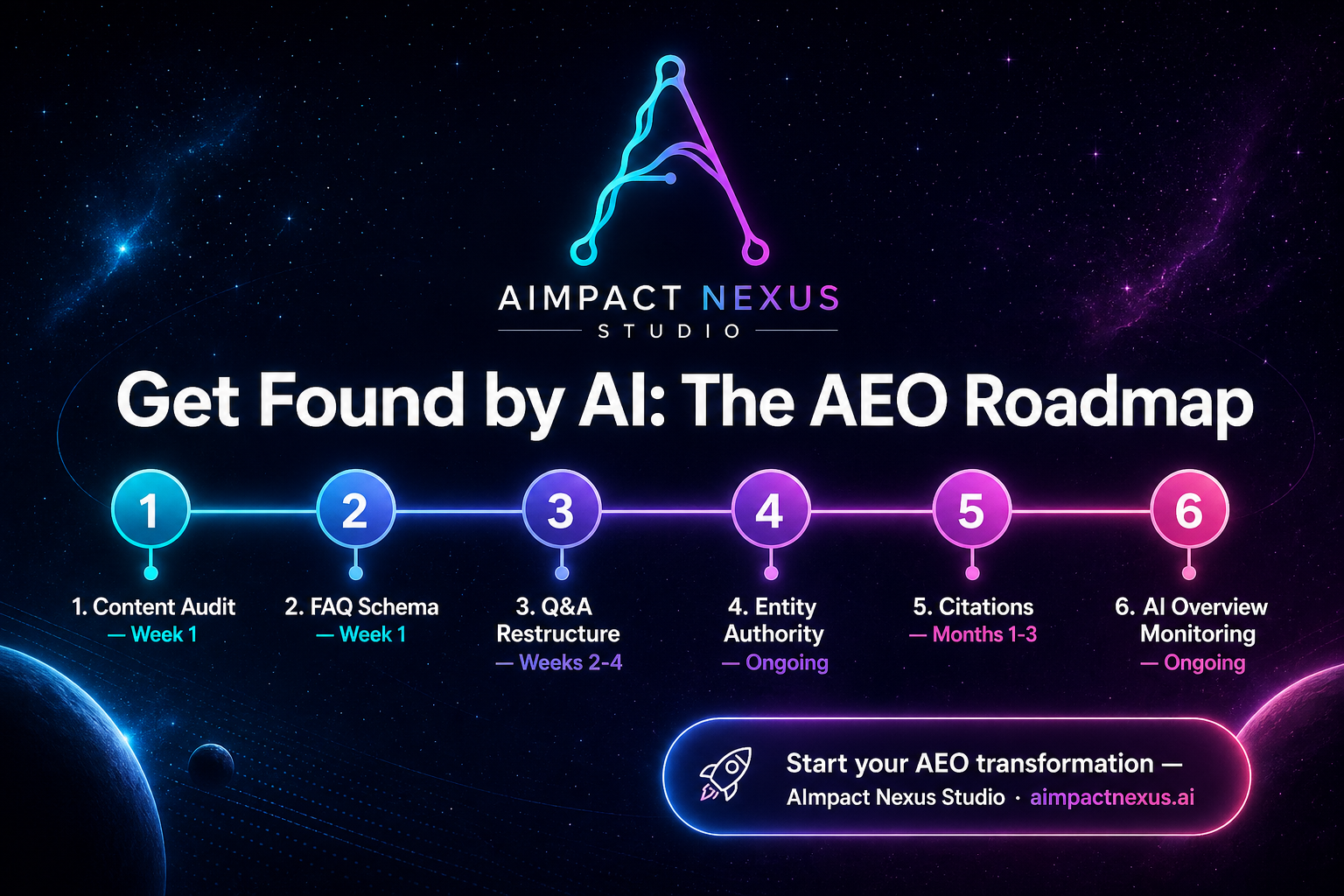
We run every AEO engagement through the same six phases, in this order, because skipping or reordering them is the most reliable way to waste money on AEO.
Step 1 — Content Audit · Week 1
Every AEO project starts with a structural audit of your existing site. Not "is this content good?" — that is a content question. The audit asks: can an AI engine parse this site at all? We score the site on a 12-point AEO health check covering structured data, llms.txt presence, sitemap quality, FAQ schema, page-title question structure, content depth per topic, internal linking, and freshness. The deliverable is a numeric AEO score and a prioritized fix list.
Most businesses score in the 20–40 range on the first audit. That is normal. The point of the audit is not the score. It is to know exactly which fixes will move the needle in the next five weeks.
Step 2 — FAQ Schema Deployment · Week 1
The single highest-ROI AEO action is adding properly-formed FAQPage schema to your top 5 to 10 pages. AI engines extract Q&A pairs and cite them with high confidence. Pages with valid FAQ schema get cited at roughly 3.2× the rate of pages without it.
This is the same week as the audit because the audit identifies exactly which pages need FAQ schema first, and the deploy is a same-week ship.
Step 3 — Q&A Content Restructure · Weeks 2–4
The deepest work in the roadmap. Existing service pages, capability pages, and blog posts get rewritten so the H2 and H3 headers are real questions a buyer would ask, and the first two sentences below each header answer the question directly. AI engines extract those direct answers and cite them.
This is also the phase where we publish llms.txt — the machine-readable summary of your business AI engines specifically look for. Most sites have never heard of it. It takes 30 minutes to draft and gives you an outsized boost across Perplexity and Claude.
Plan for two to three weeks here. It is not because the writing is hard. It is because the volume is significant — typically 15 to 30 pages — and because every page needs a human review before it ships.
Step 4 — Entity Authority · Ongoing
AI engines cite businesses they recognize as authoritative entities. Authority is built through three signals:
- Author bios with credentials. Real names, real titles, real expertise.
sameAslinks in your Organization schema. LinkedIn, Crunchbase, GitHub, industry associations.- Consistent NAP (Name, Address, Phone) across the web. Mismatches kill local AI citation rates.
Phase 4 is "ongoing" because authority compounds. The first batch of fixes ships in week 3 or 4 and the signal grows from there.
Step 5 — Third-Party Citations · Months 1–3
AI engines weight citations from outside your own website heavily. A guest post on an industry publication, a press mention, a directory listing, or a podcast appearance is worth more to AEO than another blog post on your own site. This is the slowest-moving phase, which is why it starts in month 1 and runs through month 3.
The work in this phase is not technical. It is outreach: identifying the right publications, pitching, and following up. Most businesses underweight it.
Step 6 — AI Overview Monitoring · Ongoing
The final phase is measurement. We track where your business appears across five engines (ChatGPT, Perplexity, Claude, Gemini, Google AI Overviews) for your target buyer questions, on a weekly cadence. The data tells you which engines you are winning, which you are losing, and which competitors are pulling ahead.
This is the phase that makes AEO a managed program rather than a one-time project. You will keep adding citations, fixing schema, and refining content for as long as you want to stay on AI shortlists.
How long does AEO actually take to show results?
Most businesses begin appearing in AI shortlists 4 to 8 weeks after the schema and Q&A restructure ship. Perplexity is the fastest engine to reflect changes — often within days. Google AI Overviews follow in 2 to 3 weeks. ChatGPT and Claude tend to lag 4 to 8 weeks because their training and retrieval cycles refresh more slowly.
A practical timeline:
- Week 1: Audit + FAQ schema live.
- Weeks 2–4: Q&A restructure rolling out, first Perplexity citations begin appearing.
- Weeks 5–6: Google AI Overviews start including your pages.
- Months 2–3: ChatGPT and Claude citations stabilize, third-party citations begin contributing.
- Months 3+: Maintenance, measurement, and competitive defense.
The window to be first in your category is open right now in most verticals. It will not stay open. AEO is currently uncontested in many B2B categories specifically because most businesses still think of it as "SEO 2.0" and have not started.
Where do most businesses get stuck?
Three failure modes account for almost every stalled AEO rollout we have rescued:
- Schema gets deployed but content does not get rewritten. The site has FAQ schema and llms.txt but the underlying pages still read like 2019 marketing copy. AI extracts what is there, and what is there is not citation-grade.
- Content gets rewritten but never reviewed. A non-expert produces 30 pages of generic Q&A and ships them without an expert touching the answers. AI cites them, then someone in your industry reads the citations and your authority drops.
- No measurement. The team ships the build and never instruments which engines they are appearing on. Six months later there is no data on whether AEO worked.
The fix to all three is the same: a managed AEO program with a real human expert reviewing every shipped change and a measurement system tracking citations weekly.
How AImpact Nexus handles all six steps
Most businesses cannot afford a full-time AEO team and should not need one. AEO runs on ARIA + Nexus Studio ($799/month) on the AImpact OS ($599/month) — private employee data and a Company Brain with ACLs.
What Studio does:
- Schema and llms.txt deployment. Generates and maintains structured data, FAQPage schema, and llms.txt automatically as you publish new content.
- AI-assisted content restructure. ARIA drafts question-headed Q&A pages from your existing copy and your subject-matter experts review and ship.
- AI visibility monitoring. Weekly tracking across ChatGPT, Perplexity, Claude, Gemini, and Google AI Overviews on your target queries.
- Content cadence. Auto-generated blog posts on your AEO topic queue, optimized for citation, ready for your review.
Studio is what we wish existed when we started doing AEO for clients. So we built it.
What to do this week
If your business depends on being found by buyers, three actions move the needle this week:
- Run a free SEO and AEO audit to see exactly where you stand across the five major AI engines.
- Read our companion piece on what AEO actually is if you want the full primer before you commit.
- Book a 30-minute discovery call if your category is competitive and you want to compress the six-week roadmap into a managed engagement.
The companies that show up on AI shortlists in 12 months are the ones who started in the next 30 days. The roadmap is not complicated. It just has to be done in order.
Andy Oberlin
Founder & CTO, AImpact Nexus
Want this on a box you own?
AImpact OS is $599/mo — private employee data, Company Brain with ACLs, one REINS. ARIA + Studio is $799/mo on top.
Get Your Free Audit